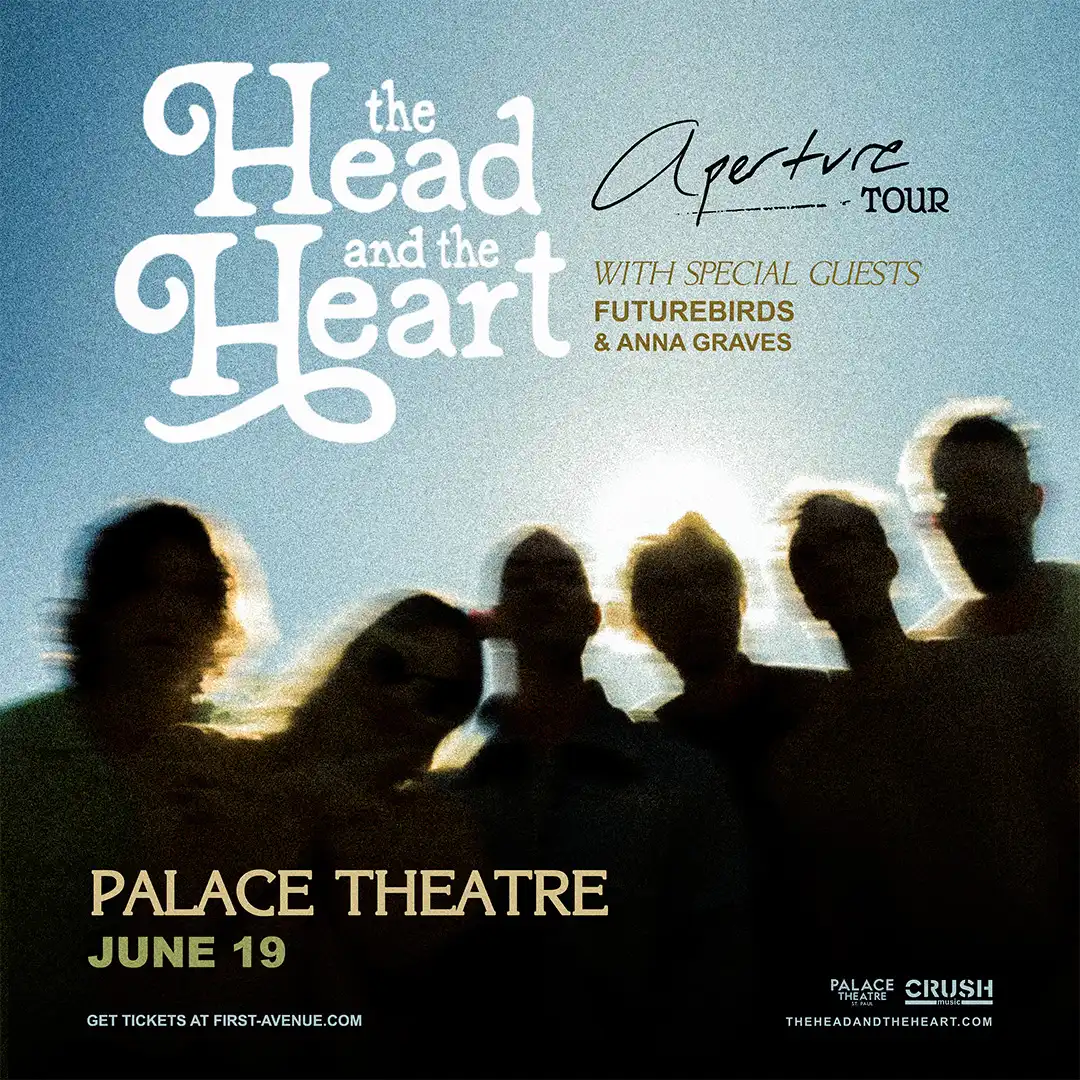
The Current presents The Head And The Heart with Futurebirds and Anna Graves
Thursday, June 19
6:30 pm
Palace Theatre
17 7th Place West Saint Paul, 55102
The Current presents
The Head And The Heart
with Futurebirds and Anna Graves
Doors 6:30pm | Show 7:15pm | 18+
How to receive presale information
A presale is scheduled for March 6, from 10 a.m. to 10 p.m. (the public on-sale opens Friday at 10 a.m.). Subscribe to Cross Currents — The Current’s weekly newsletter — by midnight March 5 to receive details about the presale for The Head And The Heart.
You must be 13 or older to submit any information to Minnesota Public Radio. The personally identifying information you provide will be used only in ways consistent with our privacy policy. See Terms of Use and Privacy. This giveaway is subject to the Official Giveaway Rules.
The Head And The Heart
As The Head and the Heart toured behind their 2022 album, Every Shade of Blue, Jonathan Russell realized something needed to change inside the band he had cofounded a dozen years earlier: the entire songwriting process. At the start of the last decade, with their self-titled debut, they’d instantly bloomed at the fertile intersection of indie rock and folk-rock like some rare flower. Their massive harmonies and pulsing arrangements suggested a cadre of old friends, working together to share some new emotional burden—a band, really. But the tandem of success and encroaching adulthood had forced sometimes-unspoken changes over the years, with Russell often taking on lead songwriting duties, even bringing in outside collaborators to bolster his ideas. That early band energy faded a bit, The Head and the Heart becoming more a team of collaborators adding or even playing parts for songs that were almost ready to record. On stage, they could all feel it: a slight disconnect from the songs, a slight disconnect from one another. The Head and the Heart needed a restart.
Aperture—The Head and the Heart’s sixth album and their first since signing to Verve Forecast—is the affirming result of that realization. After working with a string of marquee producers on their previous three albums, the six members took the lessons they’d learned into studios in Seattle and Richmond, patiently shaping and self-producing a record that satisfied no one but themselves. More important, though, they tossed out the codex that dictated who did what. After leading so much of the songwriting during the last decade, Russell ceded that role to everyone, shooing away siloed work for a highly collaborative approach where everyone hatched tunes together in a room or passed ideas between coasts. Some members wrote and sang for the first time; others redoubled their commitments and contributions. More than any other record ever by The Head and the Heart, Aperture feels like the work of a real band, made giddy by the process of once again sharing some emotional load. With every song fortified by the sense of beginning again, Aperture is The Head and the Heart’s most vital and poignant album. It is the best work they’ve ever done.
There was, though, some early worry it might not cohere, that everyone might not have the same chance to fit and lift. As spring arrived in Richmond in 2023, four members—Russell, bassist Chris Zasche, pianist Kenny Hensley, and drummer Tyler Williams—rendezvoused there to do what the band had rarely done: simply jam, with few if any preconceptions of the songs they might write. Weeks earlier, Charity Thielen and Matty Gervais had their second baby, so they stayed home in Seattle. After all, the stakes seemed low, since this was unstructured exploration.
But the quartet instantly tapped into a renewed enthusiasm, a tide of ideas rippling out in a matter of days. There was a rawness and unfettered energy to these songs. A band that had built a massive audience with meticulous arrangements and studio perfection suddenly found a vim that bordered on punk. There was a boundlessness to it all. Williams even sang lead for the first time, boosting an explosive Russell tune called “Cop Car.” And the first bits of a first song by Hensley were taking shape. How would Thielen and Gervais respond to this new exuberance? Was it too much?
Not at all: The couple responded in kind, excited not only by the material the ad hoc quartet had written in Richmond but the attitude of boundless teamwork they’d embraced. Across a half-dozen subsequent sessions and countless more casual hangs, songs simply seemed to leak out of The Head and the Heart, some inspired by bits of kismet and others by deliberate teamwork. In the former field, for instance, Russell left a guitar in Gervais’ home studio in an unlikely tuning after a session. When Gervais picked it up days later, he heard something he liked. On New Year’s Day 2024, he played the snippet for Hensley and, they quickly wrote “After the Setting Sun,” turning Russell’s accidental gift into the cascading album opener. Gervais repaid the favor on “Pool Break,” a contemplative number about what we want but might not get from childhood that Russell started in those Richmond sessions. Russell thought the song was done, but Gervais helped him reconsider the structure, to emphasize the idiosyncrasy of its rhythmic dynamics and falsetto vocals by adding balance. It’s a testament to the unexpected bounties of collaboration, to letting go of control among people you trust.
Actually, all of Aperture feels that way, the work of a band reaching unimagined levels of camaraderie and mutual risk as one. A spirited homage to honesty and love, “Jubilee” is like the sun suddenly bursting from the clouds. It bounces like a piece of pop-punk and arcs like a Springsteen classic. As Zasche and Williams strut in the rhythm section, the rest of the band yearns for better days during “Beg Steal Borrow,” The Head and The Heart’s trademark harmonies conjuring communal aspirations. The transfixing “Finally Free” begins with Thielen alone, offering vivid images in her endlessly inquisitive tone above toy piano; as the rest of the band slowly joins, they help lift her above the hurdles that she limns. There may be no better summary of this fellow feeling than the mighty “Arrow,” a shout-along song about sometimes needing the space to roam and fail on your own and sometimes needing to be guided and helped by those around you. The Head and The Heart has finally found a way for its six members to find their own ideas and then build them, as one, into something magnificent.
For a long time, The Head and The Heart wasn’t sure what to call this record. There were, after all, so many poetic gems from which to borrow within the record, so many bits of insight into how we move forward through seemingly impossible times. Why not After the Setting Sun, for the album’s beautifully arcing opener, or Finally Free, for the band that had found both a new label home and collective synergy? But as they were in the final stages of mixing, they landed on Aperture, the cathartic closer about the redemption of perseverance, about what hopefully arrives after a very hard spell. “Sun was made for coming out/even though the night is long,” they sing together beneath galloping drums, another iconic crescendo for a band that made its reputation with them. It’s a fitting credo for a band that’s seen so much in its dozen years.
As important, though, was the way it was made. Long known as “Kenny Piano Song,” it began as a series of keyboard progressions by Hensley, the band adding layers in real time. What, though, should it say? For weeks, Gervais listened to the instrumental as he walked through old-growth forests near Seattle, his and Thielen’s newborn strapped to his chest. He wrote a line at a time that way, eventually landing on this anthem for togetherness and endurance, for all of us moving forward, arm in arm. It is a lesson The Head and The Heart learned by giving themselves time and space to make Aperture, a band finding again its shared footing. And it is a lesson that feels as timely as these songs now, as we look for more ways to share our collective burdens.
Futurebirds
Momentum. Evolution. Expansion. Those are important traits for a critically acclaimed group that recently celebrated its 15th anniversary. "When you've been a band for as long as we have, there's a lot of moving on," says Thomas Johnson. "We just keep going, because that's how you keep things fresh. That's how you keep the spark." By matching the sharply-written songs of three distinct frontmen with a progressive mix of rock & roll, electrified folk, and cosmic American roots music, Futurebirds have built an audience that's as wide as the band's own sound. With Easy Company, Futurebirds' fifth studio album, that sound reaches a new peak.
Featuring four songs apiece from singer/songwriters Womack, Johnson, and Carter King, Easy Company feels like a celebration of the tight-knit bonds that have held Futurebirds aloft since 2008. Back then, the guys were college students at the University of Georgia, building a buzz around town with shows at fraternity houses and local bars. Years later, they've become headliners at bucket-list venues like The Ryman and The Fillmore, collaborating with fellow genre benders like My Morning Jacket's Carl Broemel along the way.For Futurebirds, the road goes on forever. Easy Company is the latest stop on a journey that's still unfolding, winding its own path through American rock & roll, giving Futurebirds and the grassroots community they've created — the Birdfam — a new place to land.
Anna Graves
Minnesota-born singer, songwriter, and multi-instrumentalist Anna Graves pens songs with the candor of a late-night conversation where nothing is off the table. As she navigates the vast landscapes of human emotions, Graves stands out as an artist who fearlessly explores the raw depths of the human experience. On her forthcoming project, she says goodbye to past selves and regrets, confidently connecting to the now.