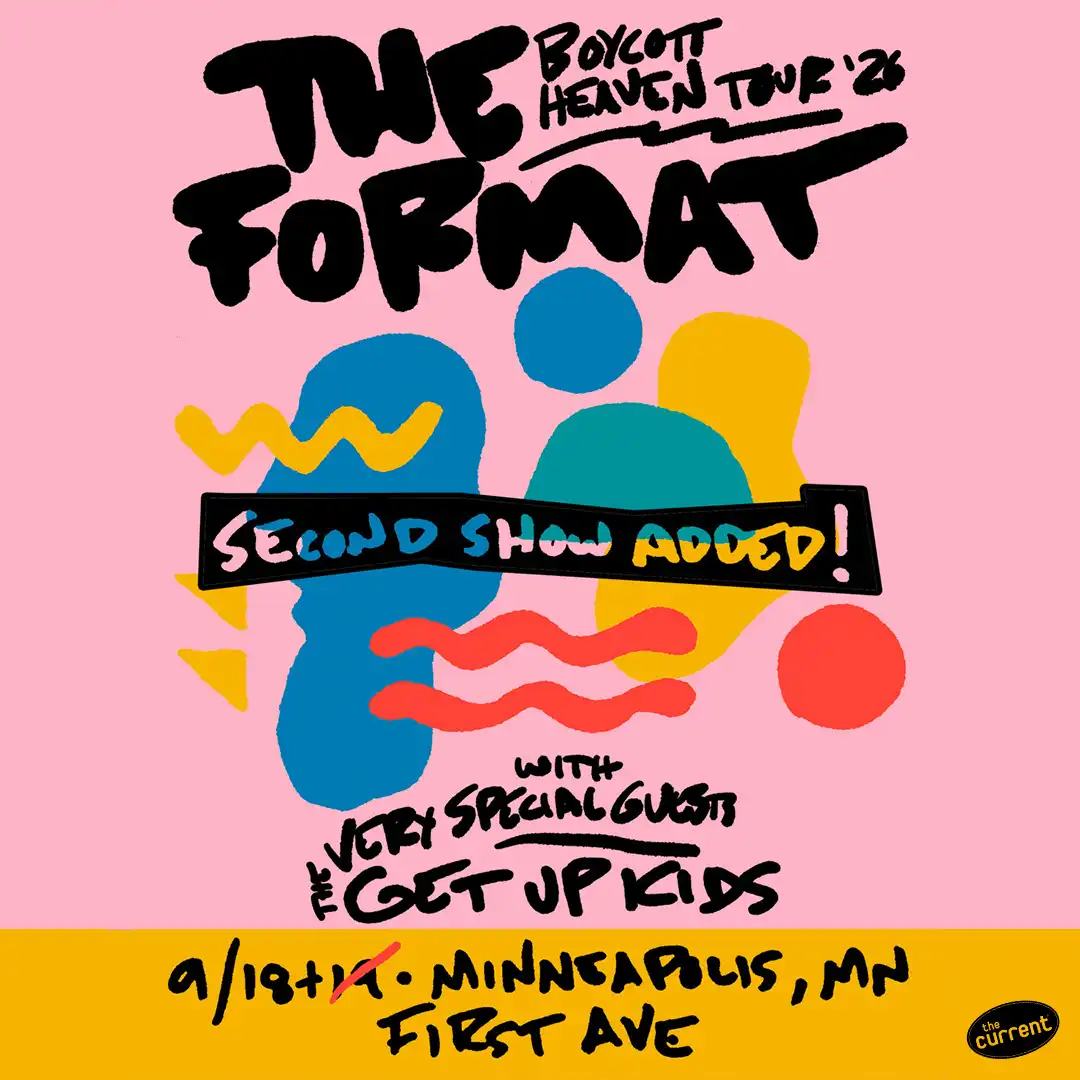
The Current presents The Format
Friday, September 18
6:00 pm
First Avenue
701 1st Ave N, Minneapolis, MN 55403
The Current presents
The Format
with The Get Up Kids
Doors: 6:00 p.m. | Performance: 7:00 p.m. | All Ages
The Format
The Format was beginning to think the stars were aligned against them.
Just as Nate Ruess and Sam Means were finally able to sort through the aftermath of the 2020 pandemic-which first stalled, then completely wiped out their last attempt at a reunion-tragedy struck again. On the very first day of recording new music in nearly 20 years with Grammy-winning producer Brendan O’Brien (Pearl Jam, The Killers, Bruce Springsteen), the Los Angeles wildfires broke out, leaving devastation across the city. It was enough to inspire a little conspiratorial thinking.
“It seriously felt like the universe was against us,” Ruess says, trailing off. “It was at least…” “It was testing us, for sure,” Means adds, finishing the thought.
It’s no wonder that Boycott Heaven, their third album, is charged with there is no waiting on tomorrow energy. After all, if the universe was in fact putting you through your paces, how might you respond? Not on some far-off imagined judgement day, but right now?
“Holy roller, don’t go wasting all your time,” Ruess sings in the boisterous single “Holy Roller.” In other words, the time for creating something more like heaven isn’t tomorrow or some other day, but today.
A certain romantic fatalism has always coursed through The Format’s lyrics, which the more mature Ruess cops to in the heartland rocker “Shot in the Dark.” “Lived my whole life like I was ready to die,” he confesses over jangling guitars and stomping rhythms. But Boycott Heaven is filled with reflections on reasons to stick around this broken old world: family, life-long connections, distorted guitar riffs, and a stubborn belief that even as bad as it is, tomorrow could be better.
Once it was safe to return, the duo got back to work at Henson Recording Studios. Sam and Nate both played electric guitars-Ruess having picked up the instrument in the years since The Format’s last album, in addition to launching a solo career, forming the chart-topping fun. with Jack Antonoff and Andrew Dost, and collaborating with P!nk, Kesha, and Hayley Williams of Paramore.) Their rhythm section was comprised of O’Brien on bass and drummer Matt Chamberlain (David Bowie, Bob Dylan, Soundgarden, Fiona Apple,).
Fans of Interventions + Lullabies (2003) and Dog Problems (2006) will recognize the hooks and retro-pop bravado, but Boycott Heaven signals a new era. It’s not a nostalgia play, even as it incorporates sonic nods to the alt-rock, grunge, and pop-punk sounds Ruess and Means first bonded over as Arizona teenagers.
“We first bonded listening to bands like Weezer, Pearl Jam, Stone Temple Pilots,” Ruess says. “I’m a new guitarist, just enamored with power chords, so I’m listening to all this stuff we’d listen to back then and cross referencing—NOFX, Lagwagon. But you take that pop-punk stuff and slow it down, and then have Matt Chamberlain playing on it, and then it feels a little like grunge. All that’s in there.”
“It does kind of bring us back,” Means says, not just in terms of time but “As a partnership, too. It feels like a cool extension of where we came from.”
Though the concept of recording with a mega hit producer was intense at first, Means says O’Brien made it easy to focus on the music. “Brendan just being Brendan made it so that we could focus on being there to make a good record and have a good time,” he says. “Not that it wasn’t a whirlwind, cause it was. When it happened, it happened fast.”
With steady hands like O’Brien and Chamberlain backing them up, Ruess and Means didn’t have to worry about second guessing the implications of following up their past work-the act of creating new sounds kept them entirely occupied. The results are diverse, from the power pop charger “Depressed,” which hinges on buzzsaw guitars and close harmonies, to the folk ballad “Right Where I Belong,” to the rousing anthem “No You Don’t,” which sounds like a lost Pinkerton B-side.
Even as they disbanded, The Format never closed the door entirely to future collaboration. Steadily resisting the “emo nostalgia” bucks offered to them, Ruess focused on new projects, and Means devoted himself to solo musical work and his independent music merchandise company, Hello Merch.
When Ruess contacted him in August 2024, he didn’t realize that right away the band was actually flipping the switch into “new Format music mode”, though the work quickly revealed the path, and the two found that their years apart hadn’t dulled their creative psychic connection.
“At first, we weren’t even sure,” Means says, noting that when Ruess reached out with set of guitar-based demos, a new mode for the mostly vocals-based composer, he thought they might be songs intended for the follow up to Ruess’ solo debut Grand Romantic (2015), but as they bounced ideas back and forth, it became clear what was happening.
“It was like, ‘Well yeah, this is a Format record,’” Ruess says, “What else could it be?”
Though Means admits he knows some people will read the words “boycott heaven” and immediately form an opinion, Ruess says the title came to him more or less by accident. “It was a hashtag on Twitter. I read ‘boycott heaven’ but it was ‘boycott Heineken,’” he says, stifling a laugh. “But I just thought the words sounded beautiful together. It’s not an anti-religion record—I think religion can be a beautiful thing—it’s just when something is out of balance, sometimes a boycott is in order.”
Ruess cites Paul Schrader’s Ethan Hawke-starring masterpiece First Reformed (2017) as a major inspiration on the album, and just like that bleak, beautiful movie, Ruess doesn’t avoid thorny topics-from religion to fake friends, all while maintaining an empathetic stance that’s less about preaching and more about observing.
“I would love nothing more than to write about the world in a cheesy way,” Ruess says with a wry laugh, but instead, Boycott Heaven portrays the world as it is: full of beauty, sadness, and always, no matter how hard to see, possibility.
Following sold-out reunion gigs in Phoenix, Los Angeles, and New York, where songs from Boycott Heaven were debuted live, the new album signifies both a rebirth and continuation of The Format. When the band originally disbanded in 2008, their goodbye note made reference to a Twin Peaks DVD boxset Ruess and Means were passing back and forth, in an attempt to unravel the show’s mysteries. While cutting Boycott Heaven, Means insisted they devote a deep dive watch to 2017’s revival series, Twin Peaks: The Return. The mysteries-and the magic-remain.
Like Mark Frost and the late David Lynch returning to their beloved fictional Washington town, Boycott Heaven is the product of two longtime confidants creating something they could only create together, changed by time but still tied to their roots.
“Been gone for way too long,” Ruess sings on album closer “Back To Life.” “I never meant to say goodbye,” he follows up. The song signifies a new start, a new beginning, and a new chapter in the story of The Format.
The Get Up Kids
In the two and a half decades since the release of their landmark second album Something to Write Home About, the four core members of The Get Up Kids — Matt Pryor, Jim Suptic, Rob Pope, and Ryan Pope — have explored side projects, helmed solo ventures, and held stints in high-profile bands. They’ve also started businesses, found spouses, and raised kids. Still, run into them on the streets of Lawrence, Kansas, these days, and you’ll find that — perhaps beneath a beard — each has retained the high-spirited, unwavering authenticity that fans stood feet from at basement shows before the band’s sophomore breakthrough.
Something to Write Home About has landed in a similar place: recognizable as the same electrifying, scrappy album it was upon release, but also transformed by time into one of the most seminal records of the band’s scene. And to mark 25 years since its arrival, The Get Up Kids will perform the album in full throughout a lengthy North American headline tour.
Released in September of 1999, Something to Write Home About has been established as an important late-millennium rock-and-roll document; a convergence of power pop, alternative rock, and punk, it provided the parameters for emo’s Midwest-centered second wave. Youthful yet assured, the album expands and refines the sound of the band’s 1997 debut Four Minute Mile. Amplified and acoustic guitars by Pryor and Suptic are coupled with keys and synths provided by former member James Dewees. Throughout, strings and celeste mesh with pop-indebted harmonies as the Pope Brothers’ rhythm section propels each song. The lyrics, carried primarily by Pryor’s pugnacious vocals, use relationships as a springboard to explore betrayal, conviction, and ambition. His plainspoken poetry is in turn direct and oblique, all kindling for fresh fires in addition to those already burning for decades of faithful listeners.
Today, Something to Write Home About still sounds like the lodestar it was for its fleet of followers, but it also retains something singular: an affecting, unaffected quality richer than its genre associations, bigger than its hooks, and deeper than mere twentysomething turmoil. And through emo’s reappraisals and revivals, the band–which now includes keyboard player Dustin Kinsey–has carried on, releasing albums, remaining friends, and playing all over the world.
The upcoming Something to Write Home About anniversary tour will be a chance for fans to rediscover the album or to revel in a classic they’ve never forgotten, and experience it live with the brash, big-hearted band that loves it as much as them. “Anybody can start a band when you're 20 and go on tour and have a couple of years of fun with that. But what it became, at least to us, is the reason that we can still do this now,” says Pryor. “We are doing this as a celebration, and we're going to have a party every night on stage.”