Recording from 1962 captures Doc Watson's emergence onto the American folk and roots music landscape
March 03, 2020
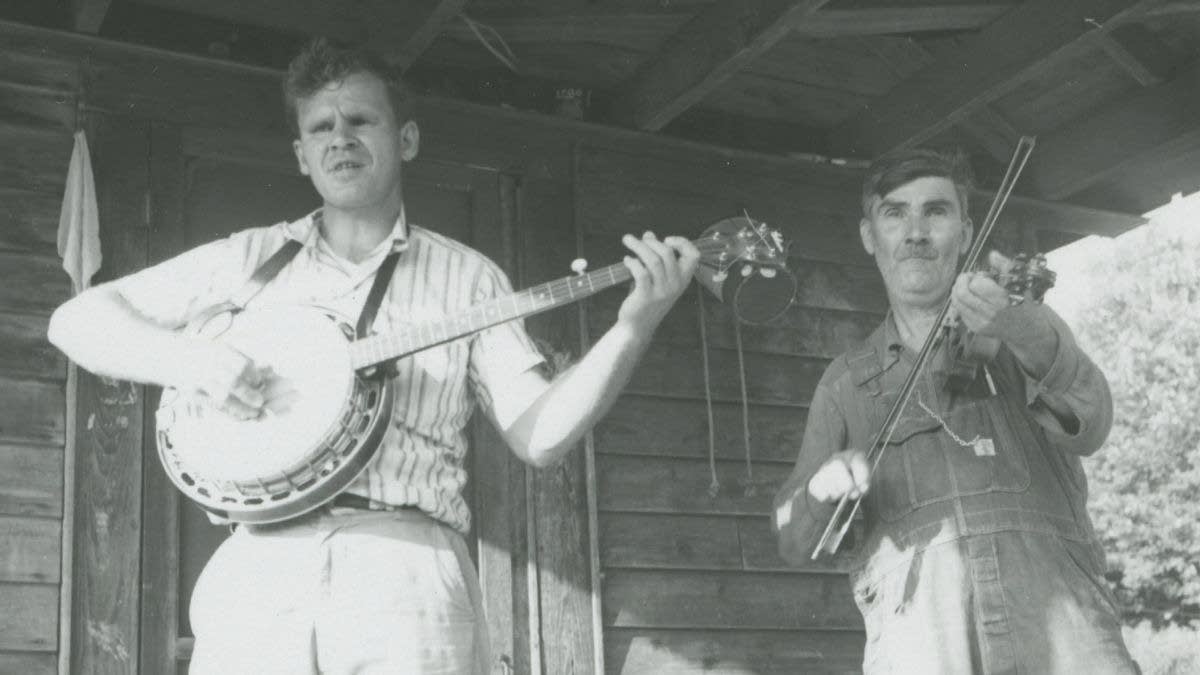
Doc Watson is such a vital part of American folk and roots music that it's hard to imagine a time when his brilliant guitar playing and Appalachian roots weren't a part of the fabric of roots music in the United States and beyond. A renowned artist in his day and a continuing influence on roots music, Watson happened into the music industry much by accident, discovered (if you will) by noted folklorist Ralph Rinzler in the early 1960s, when Watson was mainly playing rockabilly tunes on the electric guitar near his home in tiny Deep Gap, N.C.
This came at a time when America was captivated by a folk-music revival, and Rinzler convinced Watson that music fans around the country would be interested in the older music of Appalachia, and the nation soon fell in love with Watson's heartfelt, powerful singing and his inimitable acoustic guitar playing. He inspired countless people to pick up the guitar and learn to flatpick the old melodies, much of this encouragement coming in person after performances.
It was at the first of these shows in New York — Watson's first time headlining a show in the city; he was there once before as one of two guitarists in Clarence Ashley's band — that audiences got to hear this old music played by Watson and his fiddling father-in-law, Gaither Carlton.
These live recordings from 1962 comprise the album, Doc Watson and Gaither Carlton, releasing May 29, 2020, on Smithsonian Folkways. Most of these tracks have never been released before, and the recordings capture two masters at the height of their power, reveling in an audience who were there to listen, not just to drink and dance. The recordings come from two concerts in New York City in October 1962; one concert at the NYU School of Education and the other at Blind Lemon's (a folk club in the West Village that was gone the next week). It's a moment where the rural Appalachian world of North Carolina came face to face with the urban New York world of young people desperate to learn folk music and to learn more about the Southern traditions they'd been discovering. The recordings show two very different worlds coming together, buoyed by Watson's charming personality and his willingness to teach all who would learn.
Rinzler set up the concerts as Watson's debut in New York, but it was an 18-year-old Peter Siegel who recorded both concerts. Siegel still lives in New York, and he went on to an accomplished career in the music industry, including becoming head of A&R for Polydor. During those wintry nights in New York in 1962, however, Siegel was just a teenager with a recording device, and he captured a truly special concert. "Today there are all these great flatpicking guitarists we know about," Siegel says. "Clarence White, Tony Rice, all kinds of people. Billy Strings too, now. [But] at that time, nobody had ever heard a folk guitar player play like that. In folk music, the guitar was an accompanying instrument, which was usually strummed in a specific way. So when Doc showed up, it blew my mind. It blew everyone's mind!"
The music that Doc Watson and Gaither Carlton played on these recordings is not the powerhouse virtuosic guitar style Watson would later be known for; as it happens, Watson actually plays banjo on half the tracks. "This is family music with intricate interweaving of fiddle and guitar, or fiddle and banjo," Siegel says. "This is the music that Doc and Gaither had been playing at home for the last 20 years. On this record, you can hear the older stuff, you can hear flashes of brilliant guitar playing, but that's not what the album is about."

Gaither Carlton was himself a fiddler of great power. His stately playing reflects the Scottish and Irish roots of the music, and he knew seminal old-time fiddlers from the 78 RPM era, such as fiddler G.B. Grayson (1887 – 1930) of Grayson & Whitter. Whereas Watson grew up in a household with a record player and access to the radio, later basing much of his music on songs he discovered over the airwaves, Carlton came from an older world and learned his music from his family and friends directly in his region of Appalachia. "Gaither Carlton's playing is a lot like his personality," Seigel explains. "He was very humble and soft spoken. Now I listen to it again, I see he's the soul of old-time music. He just brings out the essential quality of that music tradition."
In the recordings, not only is the love from the audiences for the performers palpable, but also the love between Doc Watson and Gaither Carlton. As they play, Watson at one point encourages Carlton with a "Fiddle it, son!" exclamation.
"These recordings were made at a particular time in Doc's career when he's just figuring out that people like to hear this old-time music," Seigel says. "You can hear his surprise and happiness that the audience is responding in such a way. He's clearly having a real good time."
Doc Watson and Gaither Carlton releases May 29, 2020, on Smithsonian Folkways.