Interview: Mitski talks about 'Nothing's About to Happen to Me,' cats, and being trapped in your own mind
by Gannon Hanevold and Natalia Toledo
March 03, 2026
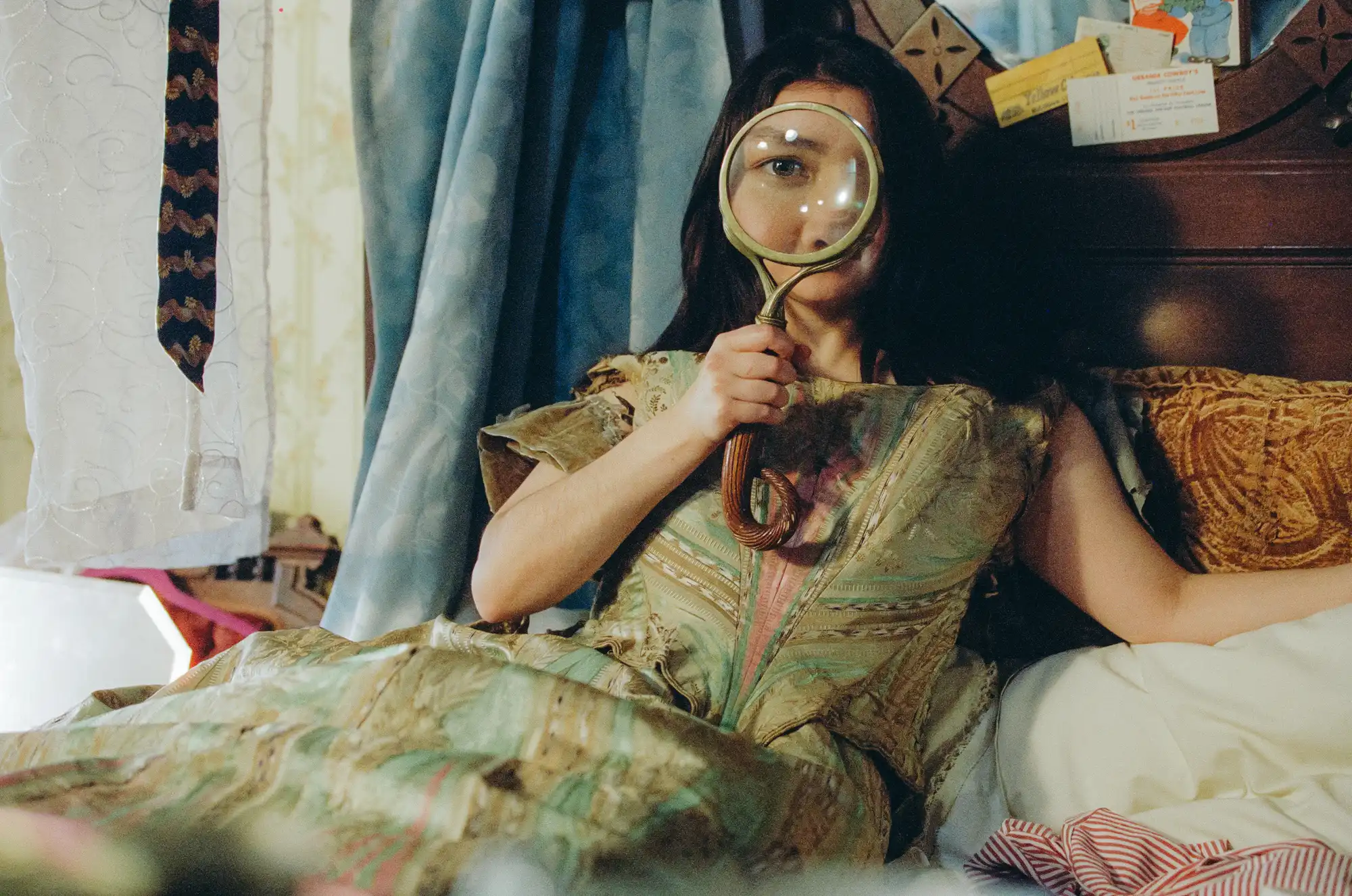
Singer-songwriter Mitski spoke with host Gannon about the process of creating the sound and imagery of her latest album Nothing’s About to Happen to Me.
Listen to the full interview in the player above, and find a complete transcript below.
Interview Transcript
Gannon: You're listening to The Current. I'm your host, Gannon, and I am very lucky to be joined today by one of the brightest, most creative minds in all of music right now, the brilliant songwriter, sonic shapeshifter from album to album, all of the above. Mitski is here with us to discuss her new album, Nothing's About to Happen to Me. Mitski, thank you so much for being here.
Mitski: Hi. Thank you so much for having me. That was incredible praise. I am radiating.
Gannon: Well, I've been loving your music for a long time, very excited about the new record, and before we talk about the album, we can't talk about it without first talking about the album cover, because that, to me, is an early entry on the list of this year's most-distinct album covers, it's one of my favorites. It's this oil acrylic painting by the artist Marc Burckhardt, right?
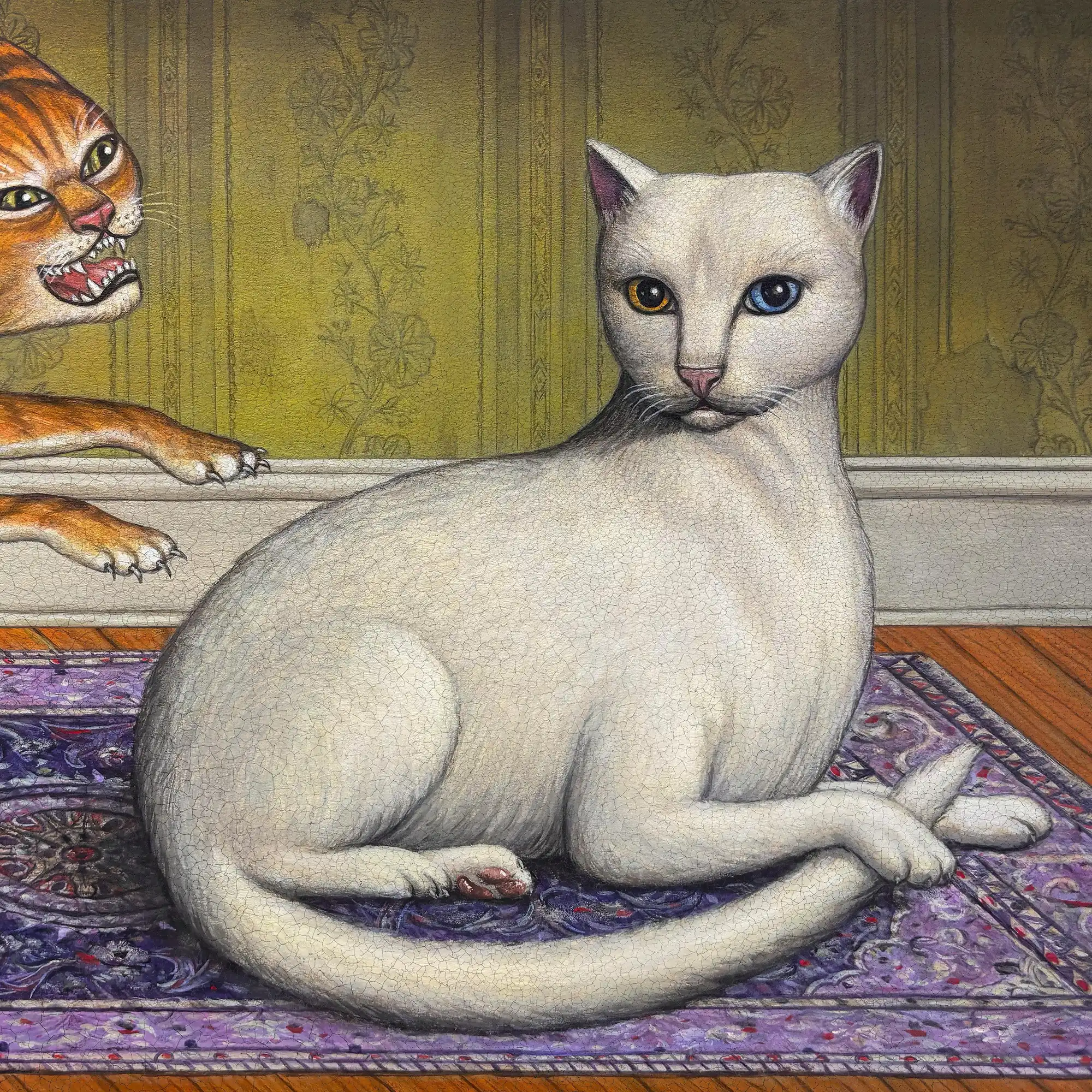
Mitski: Yeah. So the album art started with basically the idea in my head, which is exactly portrayed in Marc's painting. I had this mental image of a cat in the foreground, oblivious, blissfully unaware, of a cat in the background about to pounce on it, and the title, Nothing's About to Happen to Me, is basically coming from the cat in the foreground. So basically, I explained that concept to Marc, and then he took it from there, and I had no notes.
Gannon: Well, it's great. It conveys this sort of immediate sense of dread that really sets the tone for the album. There's this sort of, this looming doom.
Mitski: Yeah, well, exactly! Me and Mary, the designer, my longtime designer for my album artwork, actually, we scoured the web for a lot of artists, and Marc really drew our attention because he's a student of an old style of painting, and all of his work has this really kind of, like, ancient, kind of old feeling to it in a cool, mysterious way. And he paints animals really well, in a way that makes the animals seem like they know something. And we were really drawn to that.
Gannon: Yeah, that definitely comes across on the cover, especially the white cat. Now this main character, almost of the project, with those really distinct, heterochromatic, I think it's called? The eyes when they're different colors.
Mitski: Yeah.
Gannon: And I know cats come up quite a bit on this record. And you're no stranger to depicting pets as a sort of metaphor in your lyricism. I know it's been years since "I Bet on Losing Dogs," and on the last record, The Land Is Inhospitable and So Are We, I think a lot about the barking sound effects at the end of "I'm Your Man" as this really distinct moment at the end of that record. What was it that made cats the right symbol for this new project?
Mitski: That's such a cool question. Thank you. The general character I had in mind for this album concept is this sort of reclusive, weird woman living alone in an old house that maybe she inherited but can't exactly manage. I wanted to explore kind of like a house as a person's mind and all the stuff accumulating in an old house, like the various generational traumas that might accumulate in a person's mind, and in the context of that, and the protagonist being so female-coded in my mind, I thought about cats and how often there are people, especially dog people, who don't like cats because they think cats are mean, when actually, I think the layer below that is that cats just aren't obedient. It's not in their language or mentality to follow commands. It's not that they don't love people. It's not that they don't feel affection. It's just that they're not dogs. They don't follow a pack hierarchy. They just live independently. They love you how they love you, and they do what they want. And I think often cats are demonized for that in a similar way that I think a lot of women maybe are misunderstood for that quality, just because we might not be exactly what women are supposed to be in patriarchy, just because maybe we don't, I don't know, follow certain narratives that are expected of women. Maybe because we're not obedient, we are thought of as bad. I don't know, something about it. These are the kinds of things where in a year, I'll really understand. But it was more of an instinctive feeling of the cat feels right for this character, for this general feeling of the album.

Gannon: I feel like that's the kind of answer that might convert some dog people to cat people, which is maybe one of the hardest things to do. And I say that as a born and raised dog person, so that might be —
Mitski: Well, listen. What I always say is, dog people are dog people, cat people are animal people. Cat people just love all animals, I think. So we also love dogs. We do not discriminate.
Gannon: That's good. That's good. On The Current, I'm Gannon, joined today by Mitski. We're talking about the new album, Nothing's About to Happen to Me, and Mitski, I know you're hitting the road for this record, and you're playing some different sort of, architecturally unique and stylistically unique venues across the country and across the world. I know you're even playing a high school in Los Angeles.
Mitski: Yeah!
Gannon: How are you expecting these shows to feel or look even, different than previous, more “conventional” album tours.
Mitski: Well, I knew that I wanted this album cycle, this touring period, to be shorter, so it made the selection process for venues and locations really hard, because we really had to limit ourselves. And I think it forced us to try to really figure out what we want to communicate with this album. I think there's a tendency in the music industry and other industries in capitalism, perhaps, to always think bigger is better, and to think the logical conclusion of selling out one size venue is to move on to a bigger size venue. And so the logical conclusion always seems to end up being arenas. And I didn't want to go that route, because the bigger and bigger venues didn't feel right for this album's music to me. I kind of wanted to hearken back to the feeling that my shows had maybe 10 years ago, around when I was touring Puberty 2, and the intimacy of it, the excitement of going to a place you've never been, like a high school. I'm sure a lot of people who've lived in L.A. all their lives are like, "I didn't know Hollywood High School did shows." And actually, what's interesting is it did actually used to do shows. In the '80s, I know a lot of prominent bands played Hollywood High School, but it kind of sort of fell off as a venue that bands toured through. So anyway, I just wanted to try to create this feeling of excitement, a feeling of intimacy in smaller venues or interesting venues, a feeling of like, people are going to have an experience that maybe they wouldn't necessarily have going to their regular shows.
Gannon: Well, I think that intimacy sort of comes across, and the tour has been billed as the listening experience in the Tansy House, right? And I'm no botanist, but from what I understand, tansies are these really wild, spreading weeds that are beautiful but also poisonous. And I'm just curious, the Tansy House seems like it's a very central character in this new album and in the tour. Paint the picture for us. What is the Tansy House? What are we picturing when we're inside this house?
Mitski: When we picture the Tansy House, we are picturing, hopefully, an old house that Mary [Banas], the designer and I, imagined is Victorian. It doesn't have to be. But I think Victorian houses, especially in the context of Gothic literature, is very prominent and holds a lot of meaning. We imagine a Victorian house that's not been kept up. It was once glorious, maybe, but with many generations living in it and maybe not having money, it's kind of fallen into disrepair. When we walk into the house, it's full of stuff from all these different generations, because, again, this is a house that many generations have lived in and lived through. It's a mess. It's a bit of a hoarder house. I don't think it's on purpose. It's just that I'm imagining a protagonist, a woman who lives alone in this house without many resources, and so it's really hard to keep house in a big old Victorian house where things inevitably fall apart.

Gannon: It's really interesting to think about, the smallness of a physical space and translating that into sound. And I feel like that comes across on this record because there's sort of a feeling of being boxed in, whether it's lyrically or sonically, by a lot of the the songs; you know, whether it's smartphones or relationships or death or just literally being isolated in this house. How do you go about translating that idea from a general theme into tangible music on this album?
Mitski: Well, actually, I think the music came first. So basically, I had been writing songs. The way I make albums is usually, I get to a point where I have enough songs to make an album, and once I write enough songs, and I look back on them as a whole, let's say, 10 songs. I look at 10 songs, and I'm like, "Oh, there's these themes in common." And like, "What connects these songs?" Even very abstractly. What kind of theme can I glean from this? And it's always like an interesting discovery process, because it's also stuff that's coming out of my mind, but I am often a mystery to myself, and it's only through writing and then looking at my songs later, then I'm like, "Oh, this is what was going through my mind." So anyway, I think I just looked at all the songs and I was like, "This feels like there's a common theme of feeling claustrophobic, but in your mind, feeling like there's a lot going on in your mind, feeling boxed into your thoughts and feeling wary of the outside world, feeling overstimulated, and feeling lonely and isolated at the same time." That was a jumping-off point for thinking about, OK, what kind of imagery correlates with these songs?
Gannon: On The Current, Mitski here with us talking about the new album, Nothing's About to Happen to Me. And speaking about the boxed-in themes that come in throughout the record, what's sort of ironic to me is, I feel like this is instrumentally, musically, the opposite of boxed in. It's very easy for people, especially us music fans, to label things as like, "Oh, that's indie rock." "That's alternative." Giving things a name. But this album, there's little bits of bossanova. There's a little bit of callback, almost, it feels like, to some of your earlier work, like Puberty 2, the shredding, indie-rock finales on a lot of these tracks. What felt different about making this album compared to maybe stuff you've put out previously?
Mitski: The process for me is usually I write the songs, and then I bring the written songs to Patrick [Hyland], and then we start demoing it. And from demoing it, we go into a real professional recording setting. When I first started demoing the songs with Patrick, I was insistent to him that I wanted it to feel more like rock songs. I wanted it to feel stripped down. I wanted to use the bare minimum amount of instruments, and I genuinely really wanted to do that, but it seems I can't help myself, because after we did that, I was like, "No, but I also want an orchestra." And it was also kind of, the songs eventually show you what they need and what they don't need. And it's a process of, I mean, this might sound very "woo woo," but I genuinely believe it, is sometimes you can't enforce your will onto songs. Sometimes songs just are what they are, and you have to follow what they need to be. And so, no matter my insistence in the beginning of, like, having it this stripped-down rock album, kind of like drawing on my more punk roots, the songs were like, "No, we actually need a full orchestra and a choir," you know? So that's kind of, maybe that's what the weirdness of it is, because I really started it as wanting it to be stripped-down rock songs, and they had other ideas.

Credits
Guests – Mitski
Host – Gannon Hanevold
Producer – Derrick Stevens
Digital Producer - Natalia Toledo
External Link
Mitski – Official Website