Interview: Donita Sparks of L7 on The Last Hurrah Tour and honoring Jennifer Finch
by Jill Riley and Natalia Toledo
November 04, 2026

Donita Sparks of L7 spoke with host Jill Riley about the band’s legacy, the recent passing of bassist Jennifer Finch, and The Last Hurrah Tour.
Listen to the full interview in the player above, and find a complete transcript below.
Interview Transcript
Jill Riley: You're listening to The Current. I'm Jill Riley. I'm so pleased and so happy to have a special guest on The Current. L7 formed in 1985 by the early 90s. They had a hit record Bricks Are Heavy, top 10 alternative hit "Pretend We're Dead." They founded the abortion rights nonprofit Rock for Choice. They took some time off in the 2000s. Reunited about a decade ago. In their time, they made seven albums, and they're still at it, perhaps for the last time here. Donita Sparks of L7 is on the line, I just want to say thank you for the rock all of these years, and thank you for joining The Current this morning.
Donita Sparks: I'm super stoked to be on The Current. I love public radio, and it's nice that you remember that when we played in studio, Jill, because that was really fun, and I'm not sure that the people in the control booth knew what to expect, but I think we rocked them.
Jill Riley: I love it, and I love when it gets loud in that studio. And I think maybe the infrastructure of the building was tested a little bit that day because it was heavy guitars and rock, and it was so much fun. Which, by the way, you can find that L7 in-studio performance at The Current's YouTube channel. So if you didn't see it the first time around, it's still there, and you're able to watch it. So Donita, The Last Hurrah Tour, it is landing tonight at the Fine Line, and just happened to notice, because we're paying attention around here on Election Day. You're playing in Minneapolis, so we're looking forward to you being at the Fine Line. How does it feel to to be playing in Minneapolis? I mean, you guys have been here plenty of times over the years, but when you think of Minneapolis, what do you think of?
Donita Sparks: When I think of Minneapolis, I think of the cultural hub, it's been for a really long time. You know, with underground record labels and their underground music scene. It was always when we'd be touring the country. There were certain cities that we very much looked forward to because they did have this scene. There was an underground scene in in Minneapolis. And Minneapolis has always loved little L7, and certainly we're excited to play Minneapolis on election day because Minneapolis came out so strong against ICE, and was such an inspiration to the nation, so we're stoked to be playing Minneapolis once again.
Jill Riley: I'm with Donita Sparks from L7 on The Current. Donita, I recently just rewatched the documentary that came out about 10 years ago. I found it streaming on YouTube. It's L7: Pretend We're Dead, and there were some moments in that documentary that I just I loved seeing. There was kind of the era of when you guys were in Madison, Wisconsin, at Smart Studio, making the record 'Bricks Are Heavy' with Butch Vig, and there was just something about seeing a band from L.A. in Madison, Wisconsin, with snow on the ground that I just loved seeing that, and I wonder if you could talk a little bit about that time period, because while you guys were making that record with Butch Vig, there was a lot happening, so much coming up in the world of of rock and punk and grunge and just like so many different kinds of music. But really, at the end of the day, rock music happening.
Donita Sparks: Well, first off, our drummer Dee Plakas and I are no strangers to snow. We're from Chicago.
Jill Riley: Oh that's right. You are from Chicago.
Donita Sparks: Yeah. So we know about snow and the cold. And it was funny because we when we were making that record in Madison, we rarely saw daylight. It was like we'd get in there, and then it was kind of a trippy experience. And Butch Vig had just — the Nirvana record was coming out while we were recording, and that was wild because they were friends of ours, and Butch Vig had recorded Nirvana before he recorded us, so there was a lot of electricity in the air, and there was kind of a cultural overthrow in rock from kind of heavy metal into sort of grunge, which had more of a social consciousness. I think we slayed sexism for a hot minute in the early '90s, with some of the underground bands coming up, and then some of them getting signed to major labels and having mainstream exposure on MTV and on rock radio. So it was a moment in time, and a lot of women in rock too, at that time. So it was very exciting, and I just wanted to say that this is on election day. We were recording that album, Bricks Are Heavy, and we got our biggest hit off of that, which is a song called "Pretend We're Dead," and when I introduce the song on this tour, I say, "Hey, this song's about apathy," and I wrote it because my friends weren't voting, and that was blowing my mind. And I was like, "What?" And how things can deteriorate to our current situation if you don't vote, if you don't care, if you pretend you're dead and don't get out there, then you end up 30 years later right where we are right now. So I just wanted to throw that in there. We introduced the song that way on this tour just to remind people of what the song was about, because I think a lot of people never knew what the song is about. So, that's circling back to election night.
Jill Riley: The big '90s alternative hit for L7, "Pretend We're Dead," a song that Donita Sparks wrote about voter apathy. When L7 reunited about a decade ago and hit the road. They came to The Current for an in-studio performance, and that's one of the songs they performed. And it rocked the studio walls hard. You can watch it for yourself at The Current's YouTube channel. Well, L7 is currently on the last hurrah tour, playing tonight at the Fine Line in Minneapolis. Donita Sparks is on the line on this election day of all days. Donita, I wanted to spend a little time talking about Jennifer Finch. First of all, I'm just so sorry for your loss. Jennifer passed away this past summer in July, and if I could just say, to lose someone who had such an impact on your life and the band and the music, and cancer just sucks. I'm so sorry for your loss of Jennifer. And I wonder as you've been on this Last Hurrah Tour, do you feel like she's kind of with you on this tour?
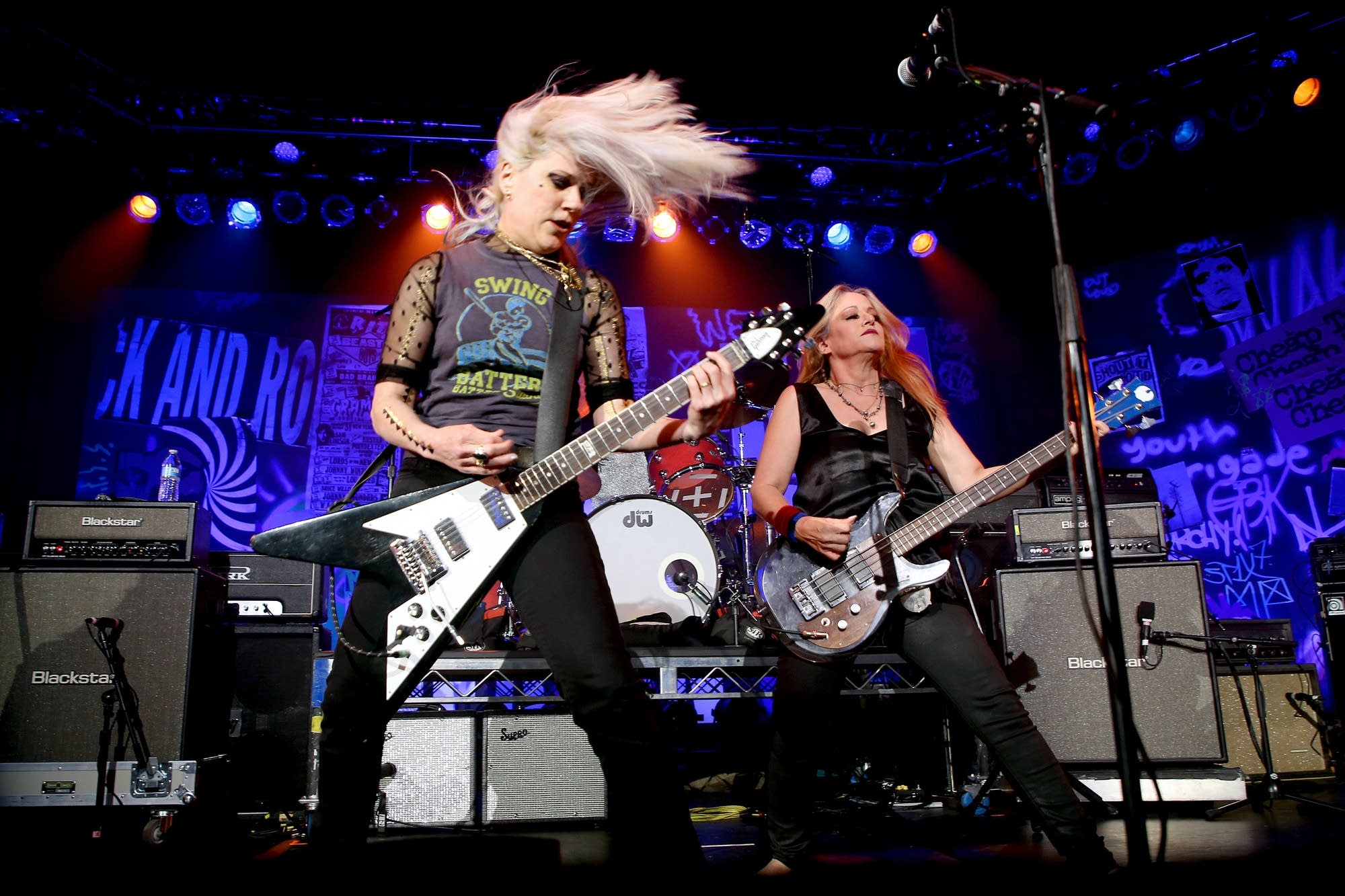
Donita Sparks: Well, you know, she died of brain cancer. It was very fast. It was very fast. It was very brutal, and the whole time we were preparing for this tour, and we had to break in some other bass players. Thank goodness, we got another gal who had played bass for L7 for a few years, named Janis Tanaka, and so she is replacing Jennifer on this tour. So she's family, she's one of us. You know, similar temperaments and all that stuff. But man, grief will get you when you least expect it. The first show we had a mini slideshow of Jennifer, and I just I could not go on. I mean, it was heavy.
Jill Riley: Yeah.
Donita Sparks: And then I've been doing fine, and I always mention Jennifer from the stage and everything, but out of nowhere, the other night in Cleveland, it hit me again. And it's just a weird, it's surreal what's going on right now, and to have all this work in front of us, and we're doing meet and greets at the shows, and these fans are telling us their beautiful stories of how we've inspired them over the years. You know, this one woman was like, "You got me through from puberty to menopause." I was like, "Wow."
Jill Riley: Yeah.
Donita Sparks: I was like, "Wow," you know. And she's like, "I've listened to you every day." So it's it's a joyous thing, and it's also bittersweet because Jennifer so wanted to be on this tour and and properly say goodbye to our fans, but yeah, we always mention her and she gets a loud applause. So, if she's not in the hall, we bring her into the hall, and that's how we're kind of coping and moving forward.
Jill Riley: Yeah, and those beautiful moments and the good memories, but then, at the same time, I mean, I know that to hear from fans has to be so touching and so moving. But then also just as your personal loss, to really go through those moments, just those little moments, where you have to take that pause. Jennifer, as I understand it, that when you and Suzi Gardner started the band, it really seemed like when Jennifer came along that there was kind of a like oh this is the moment that now we're getting some momentum, that we might get somewhere with this. Is that kind of how you look at it? You know, when it came time to starting the band and and moving forward.
Donita Sparks: Yeah, Susie and I struggled in the underground with various players for a few years, two or three years, and then Jennifer hounded me to be in the band. The catch was Jennifer did not know how to play bass. So Jennifer, Jennifer was always kind of a fake it till you make it kind of person, and she had a lot of chutzpah. And in that chutzpah, we did gain momentum because she was from LA. She grew up with a lot of people who became record company owners, like Brett Gurewitz of Epitaph, and so she knew a lot of people in that scene. She grew up in the punk rock scene in L.A. Suzi and I were more art punks from out of town, but Jennifer was pretty ingrained in a certain scene in Los Angeles. So yeah, I mean, all of a sudden we had stickers, we had a logo, we had a name, but all of a sudden we had stickers, and then we had a backdrop that she made, you know, and just these things. She had the van, so she had a lot of the pieces that propelled us forward. Where Suzi and I had the sound, and the songwriting was getting better and all that stuff. But then, but we didn't know how the hell to to propel. So Jennifer kind of helped with that.
Jill Riley: Yeah. Again, I'm so sorry for your loss, and that's just part of the legacy of the band L7 and what everyone brought to the band, whether it was the beginning, the whole journey through the '90s, and really the amount of places or spaces — I don't like to try to slap a genre on things too much, but when I think of the music of L7, it was heavy. To me, hard rock but like grit, and then but I also associate you guys with the grunge movement, and I associate with you with punk rock, and I think there are just so many different associations that I make with L7. What was it about your guys' journey through the 90s that kind of put you in so many of those spaces?

Donita Sparks: Well, we were punk rockers at heart, doing very stripped-down metal. We wanted to play hard rock, but we were punk rockers. But we didn't have the chops to go doodle doodle doodle guitar leads that go on forever, and we didn't want to do that anyway. So we have this recipe of a very a hard rock, and you know at first there wasn't a lot of melody in it and as the years went on, melody came in and some of our pop influences came in. We always had the humor, and we were always making comments on culture. I think we do fit in a lot of places, and it's cool to fit in those places because the punk community and the heavy metal community are really strong tribes. And if you have them, they are loyal for life. And so, oftentimes, we're the only women on a metal festival, but they love us, you know. And sometimes we're one of the few women on a punk festival, and they love us. And if they don't know us, they know they should respect us. So their older siblings or something school them to not mess with L7. So we are in it. We are in a unique place, and we're not millionaires by a long shot, and we don't headline these festivals, but we're up there on the festivals, so that's cool.
Jill Riley: Yeah, Donita Sparks of L7, The Last Hurrah Tour tonight at the Fine Line in Minneapolis on Election Day. It's The Last Hurrah Tour. Donita, we’ve got to wrap up here, but I understand that not only are you on the tour, but that recently a new song was released. I wonder if you could talk a little bit about that.
Donita Sparks: Yes, we did release a song on the eve of the tour. It's called "Loma Linda," which is a town in California. It is not a glamorous town, and I just thought — we had this song that was on a hard drive for years, and Dee kept bugging me. Dee Plakas, our drummer, she kept saying, "What about Loma Linda? What about Loma Linda?" And I had just never finished it, but Janis Tanaka, had played bass on it. So I was like, "Oh, this would be a cool way to reintroduce Janis into the band and finish this song." So, "Loma Linda" comes off as like a pretty song about California, but if you listen to the verses, it's a sketchy, sketchy story about an area of Southern California called the Inland Empire, which is like a real estate name for like east of L.A. by about 100 miles, which is not glamorous by any stretch of the imagination. It's it's kind of a sketchy area, and it's a sketchy story within this kind of pretty heavy song.
Jill Riley: Yeah, but I just wanted to make people aware of, there's a new song out there. Also, coming in the new year, make people aware that before Jennifer passed away, she had written a memoir, and I have it on my list. I've got it on the pre-order already. I'm looking forward to reading 'Shooting Up and Making Out: A Memoir of My Life in L.A. and L7.' So there is plenty more to come with people celebrating such a long legacy of L7. Donita Sparks, thank you so much for checking in with The Current. Have a great show tonight. Thanks for bringing the rock for all these years.
Donita Sparks: Thanks for having me, Jill, and thank you, The Current. Much appreciated getting to speak with you.
Credits
Guests – Donita Sparks
Host – Jill Riley
Producer – Nilufer Arsala
Digital Producer - Natalia Toledo
External Link
L7 – Official Website