Holiday gift ideas for Prince fans: Top 5 new books
November 16, 2026
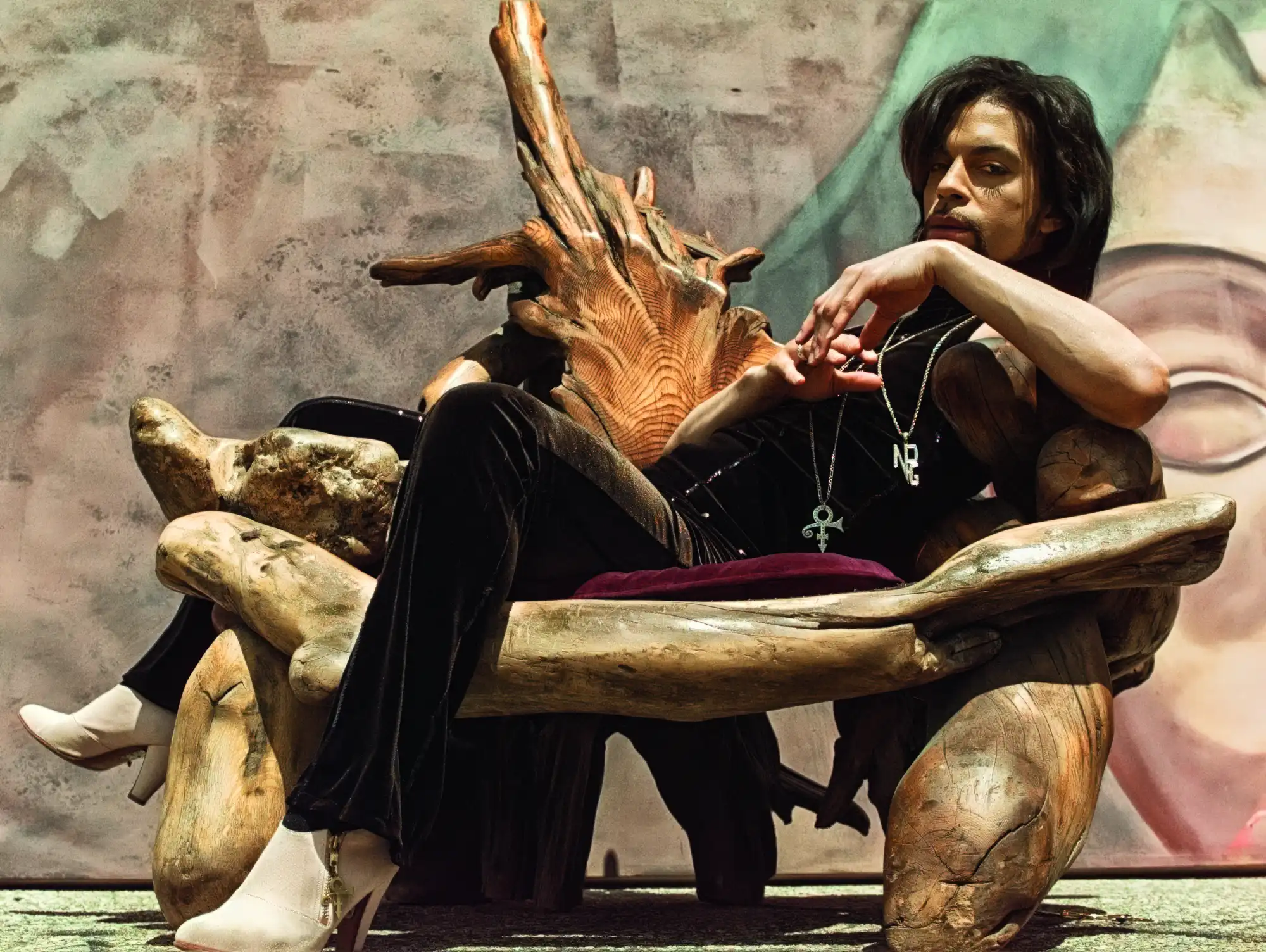
This year marked a full decade since Prince’s passing, and a slew of new books have arrived for the occasion. Some of them are more specifically about Prince than others, but he provides the fulcrum for all of them. They range from a luxuriantly oversized photo book to a book aimed at grade-school readers to a nearly unexpurgated academic treatise. All of them offer new interpretations, let’s call them, of one of the most studied of all local figures. Not all of them will satisfy every Prince fan—but all of them offer something for someone on that list.
Prince: Black, White, Color by Steve Parke (ACC Art Books/Simon & Schuster)
Steve Parke became a Paisley Park court photographer because Prince decided he would. He was already a designer there starting in 1988, when, as Parke writes in an intro to his new book of Prince photos, “One day, in 1996, Prince asked me if I’d ever heard of digital cameras and if I had ever taken pictures before.” Suddenly, it was part of Parke’s job.
Covering the years 1996 to 2001, Prince: Black White Color is a visual record dictated by its subject. “Using the digital camera, with its immediate feedback, seemed to empower him to try looks shaped by a passing whim,” Parke writes. “He knew they could be deleted if he didn’t like them.”
Knowing there are outtakes in the ether underlines the ghostly undercurrent to this collection, a giant edition made for the sturdiest of coffee tables. The period chronicled here encompassed Prince’s public break from Warner Bros. and the release of Emancipation, his marriage and divorce from Mayte Garcia, plus the premature birth and death of their son, the hopeful launch of Rave Un2 the Joy Fantastic (1999) into nowheresville commercially, and his second marriage to Manuela Testolini. You can see in most of the photos here that Prince had even more than usual on his mind.


Garcia is in a lot of these images, at Prince’s side or in his arms. But most of what holds the imagination after looking through this book is Prince solo. To shorthand it, he frequently looks like the old guy at the club, huffy and exhausted and purely jaded. Much of the time he seems to be merely posing: sexy pouting, expectant commandeering, take-me-seriously glares while holding his six-string, as if predisposing them to guitar-magazine editorial. But especially beginning in 1999, when he reclaimed his birth name as his stage name, he becomes playful again, albeit intermittently. The most relaxed shoot occurred in the Paisley Park atrium after 11 p.m., Prince in a woolly black sweater, playing George Benson's guitar (p. 52-63). It’s like a sudden, welcome visit from an old friend who this time wants to know how you are.
The most arresting later image is the spread on p. 152-53, of the maestro back-to-back with the late Angie Stone, whose darker complexion and large afro provide a deep and striking contrast. She was his peer in more ways than one, having first recorded in 1979 with the Sequence, only one year after Prince’s debut. The image stands as a tribute to her as much as him.
Prince’s Minneapolis by Rashad Shabazz (University of North Carolina Press)

It’s not for kids, per se, but at just over 200 pages, this one is a relative breeze — even when it hews to university-press academic style, it’s still readable and engaging. The author is a scholar headquartered in Arizona who did his undergrad here, starting with Southwest State University in Marshall, then transferred to Mankato State, which was renamed Minnesota State University — Mankato while Shabazz was getting his undergrad degree, as he told Deborah Copperud on her Read Minnesota Books podcast.
It helps to understand that it’s not completely a book about Prince: he doesn’t even show up as a character until about three-eighths into the narrative. That’s because the music of the city itself leads up to his arrival, from the 1903 establishment of the Minnesota Opera to the Black jazz clubs of the city’s North side prior to World War II. The book stops with the 1987 release of Sign o’ the Times — his peak, plus he moved from the city, per se, right about then, in favor of deep-suburban Paisley Park.
As Shabazz explained to Copperud: “That’s one of the big elements of the book, to show: that what was happening in the 19th Century, what was happening in the early 20th Century, and what was happening when his father and mother were part of the music scene, he inherits. And what he does is, he expands it, he builds on it, and he helps to grow what we know as the Minneapolis sound.”
The Minneapolis Sound: City, Music, Identity by Maciej Smólka (Intellect Books/University of Chicago Press)

If Shabazz’s book is written by an academic whose ideas and research also translate outside of the academy, this book, while it covers some of the same terrain, is far more rigorously bookish. While that approach does indeed compromise its readability in exactly the ways one would expect, complaining about it amounts to a category error. This is what certain kinds of theses are supposed to do: present its arguments in highly jargony language in order to prove their work, in sometimes numbing detail.
Once you learn to skip past the repetition, Smólka’s meticulousness starts to bear fruit. What the author is studying, specifically, is the very idea of “the Minneapolis Sound,” or even a Minneapolis sound—the term itself, its many varied meanings, its timelines, its implications. He’s thorough; he has to be, given his distance from the action—Smólka lives and works in Krakow, Poland, having visited Minneapolis twice, in 2018 and 2023, to do fieldwork. (Somewhat humorously, the Super Bowl, which took place in 2018, looms larger in this book than it has on the memory of the city itself.)
Smólka’s primary interviews are with five fellow scholar-participants—author and The Current alumni Andrea Swensson, the late Time drummer Jellybean Johnson, U of M professor Elliott Powell, independent scholar Suzanne Wint, and local-music historian and tour guide Kristen Zschlomer—as well as lots of written matter. And his conclusions can be surprising: “Both I-94 and I-394 had a tremendous impact on North Minneapolis, its economy, its housing market, and the general quality of life. However, they also create a specific cultural environment, which later became an incubator for a thriving artistic community.”
A lot of what is here amounts to bookkeeping: long list-like paragraphs detailing the events of the 2018 Celebration week, or an accounting of First Avenue or Target Center headliners who played a Prince song between 2016 and 2024. But in a way, all this data helps the author build a comprehensive view of how “the Minneapolis Sound” as a construct has made its way into daily life, even as its meanings remain contested: Powell, for example, notes: “No, I don’t think the Minneapolis Sound is a shared experience . . . White audiences listen to the Minneapolis Sound and may see it as a kind of color-blind music . . . They may not see it as a Black musical genre, and that’s why it’s not a shared experience.”
Swensson notes that one of Minneapolis’s challenges in the wake of the 2020 uprising is to “be able to rebuild, and that we shouldn’t just try to abandon it or flee to the suburbs . . . It’s a place worth investing in and trying to figure out a new future for.” Anyone who’s watched the city-suburb population patterns since the ’70s feels this in their bones.
Prince: A Sign o’ the Times by John McKie (Diversion Books/Simon & Schuster)

If you want to travel in the exact opposite direction of Smólka’s rigor, this gossipy tome is the place to go. The writing is quite breathless, and it can feel like a throwaway—until the author starts showing off some surprisingly insightful reporting. If you’ve read a lot about Prince, you haven’t read these quotes before; they catch the eye despite the book’s bubbly surface. Just as the title deceives by seeming to offer a look at one album, that 1987 masterpiece is not the whole of the book’s focus. Instead, McKie uses Sign o’ the Times as a prism for Prince’s entire career.
The author is still prone to Fleet Street exaggerations galore. After opening the chapter on “Starfish and Coffee” with some interesting stuff about the role dreams played in Prince’s life and work—including the tidbit that he and his early Los Angeles-based engineer Peggy McCreary mutually dreamed about one another but never discussed those dreams’ contents—he notes that Prince recorded the track for this song as its “co-writer Susannah Melvoin was asleep, quite possibly just in the middle of a dream.” Groan!
That noted, McKie does glean interesting stuff from his sources. When he goes into just what kind of boyfriend Prince made (during the discussion of “If I Was Your Girlfriend,” of course), McKie keeps the ball bouncing with real interest—lots of dish on hand here, up to and including a few strategic “who cares?” from some of the eyewitnesses. And the author has good insights sometimes as well, as when he equates Miles Davis’ sense of “the space between the notes” with Prince’s: “It’s all over Prince’s work too. It can be heard throughout Sign o’ the Times: when the title track pauses between the blues guitar and the drum machine; the echoes around the guitar solo in ‘I Could Never Take the Place of Your Man’; and ‘If I Was Your Girlfriend.” The book isn’t as authoritative as it’s going for, but its sheer moxie can carry the reader along.

Prince: A Little Golden Book Biography by Nikki Shannon Smith, illustrated by Don Tate (Golden Books)
It’s not really possible to think about this one without flashing back to the mid-’80s heyday of anti-rock preachers, the most prominent of them headquartered in St. Paul. Back then, folks like the Peters Brothers would have frothed at the mouth over the very existence of this book, and maybe they still would. Either way, the book is a marvel, and not just because it manages to tell Prince’s story to early readers in 24 illustrated pages. Heck, shearing his tale of its overtly not-for-kids elements basically just leaves 24 pages.
Needless to say, much inspirational can-do-ism is made from his life’s arc, e.g.: “In 1984, Prince starred in a movie called Purple Rain. He also wrote nearly all the music for the movie—and people everywhere loved it. He won an Oscar and two Grammy Awards for the soundtrack. Prince was now more famous than ever.” The much-simplified telling is rather charming, and Tate’s drawings of Prince at all ages are expectedly adorable. Plus, on the next-to-last page, author Smith handles our hero’s demise with matter-of-fact tact: “On April 21, 2016, Prince died at Paisley Park, after he accidentally took too much of a prescription medication.” We’ve all seen it stated a lot less elegantly than that.