Interview: Jon Batiste talks about the many ways music inspires and connects
October 27, 2025
Jon Batiste is one of the most fascinating artists working today. The seven-time Grammy winner released his latest album, Big Money, in August of this year, and soon after, he launched a tour in support of the record.
When The Big Money Tour made a stop at the Palace Theatre in St. Paul, Batiste took time to walk over to The Current studio for an in-depth interview with host Zach McCormick. During the course of the conversation, Batiste not only talks about making the album — including working with people including Randy Newman, No I.D., Nick Waterhouse and Cory Wong — but he also shares his deeply personal and spiritual connection to music itself. Batiste also shares his thoughts about what’s important to him in his life, in his music, and in his desire to reach out and help people connect with one another.
Watch and listen to the full interview in the player above, and find a complete transcript below.

Interview Transcript
Jon Batiste: Oh yeah! Sound check. [singing] Everything, everything, everything gonna be all right this morning. Yeah! Now isn't that beautiful?
Zach McCormick: Zach McCormick from The Current, joined today in studio by Jan Batiste, thank you so much for being here, man.
Jon Batiste: Yes, indeed. I'm glad to be here. I'm glad to be alive with you. I'm glad to be on this earth. You know, beautiful.
Zach McCormick: You got this awesome new album called Big Money out right now. I'd love to start by talking about the process behind this new record here; all the songs recorded kind of live in the studio, mostly working off of like, first or second takes, is what I was reading. What was exciting to you about working like intuitively, like that on an album?
Jon Batiste: Just getting back to the essence of recorded music in this era where there's so much fraudulence. There's a lot of fake expression of ideas and of political spectrums that are dividing us and putting us in a place of feeling like we don't know what's real. And then there's the advent of this technology we call artificial intelligence, which is wonderful in what it could do, even thinking about healthcare, thinking about all the ways that we could advance and synthesize ideas and exponentially grow in different fields. But I thought that making a statement that was very pure and organic and direct would be a powerful antidote to some of the woes of this time that we're in.
Zach McCormick: Totally. And the last couple of albums, studio albums under your own name that you've worked on, a little more production, a little more conceptual. Maybe it felt good to kind of work straight into the recording, work a little bit more intuitively like that?
Jon Batiste: You know, I feel like I've always thought about recording, not in terms of production, but in terms of vision.
Zach McCormick: Yeah.
Jon Batiste: So it's about the story. And every album that I've ever made has this story. It's an underlying narrative. It's a mythology, and it drives the process, and sometimes that calls for different things. The previous album that I did before this is called Beethoven Blues, and that was in the same eight months as Big Money. And Beethoven Blues and Big Money, to me, are totally different, but also similar in production, because they're all about takes, performances, capturing a moment — like capturing lightning in a bottle — just the moment that happens that is the statement, and really making sure that you get the statement before you move on. And then other albums that I've made, it's about finding how to build a scene, how to cast the scene, how to cast the movie. And every time I think of an album, by the end of it, it reveals itself to me in terms of, "This is what it is that I meant to be." The album waves at me and says, "This is who I am. Thank you for bringing me into this earthly plane." And I never think about that before I discover it through the process of doing. So I can't say that it was a response to anything I've done in the past. It more just felt the truest and rightest thing to do now.
Zach McCormick: Right. Yeah. I love that you used the word "cast" there, too, because you have this small, but like perfectly cast group of collaborators on this new record, Big Money. You got Andra Day helping you out on the opener, and you got Randy Newman, 81-year-old Randy Newman, to join you on this record. How did you bring him into the process? What was that like working with him?
Jon Batiste: Randy is one of the greatest, and I just called him one day and said I wanted to work with with him in some capacity, not knowing we'd do an album. Just wanted to get together, really, more so than work, to just kind of talk and catch up. We'd known each other in passing. Then we got together and we sat down and we had these conversations that led to us getting together in person more and more often over the course of a year. And then one day, when we were together in person, we were in his living room, and piano is there, just like this, and we were talking just like this, you know? It led to us playing songs that we loved and singing songs. And it was a powerful moment, because he hadn't been singing, he hadn't been performing like that. And as people in his circle told me, they said, "This is a revelation. We have to document this, this is a beautiful moment of him stepping out, and you're inspiring him to step out of a zone that he's been in, of not performing, not singing in a certain way." And they wanted to record it. And I thought it was great. We recorded some songs, "Lonely Avenue" being one of them, and the rest is history, as they say, right? So on the album, you can hear it. It's documented for all time. Maybe those other songs will come out one day, but we were just friends at the piano, talking and playing music and really capturing an organic expression of that moment.
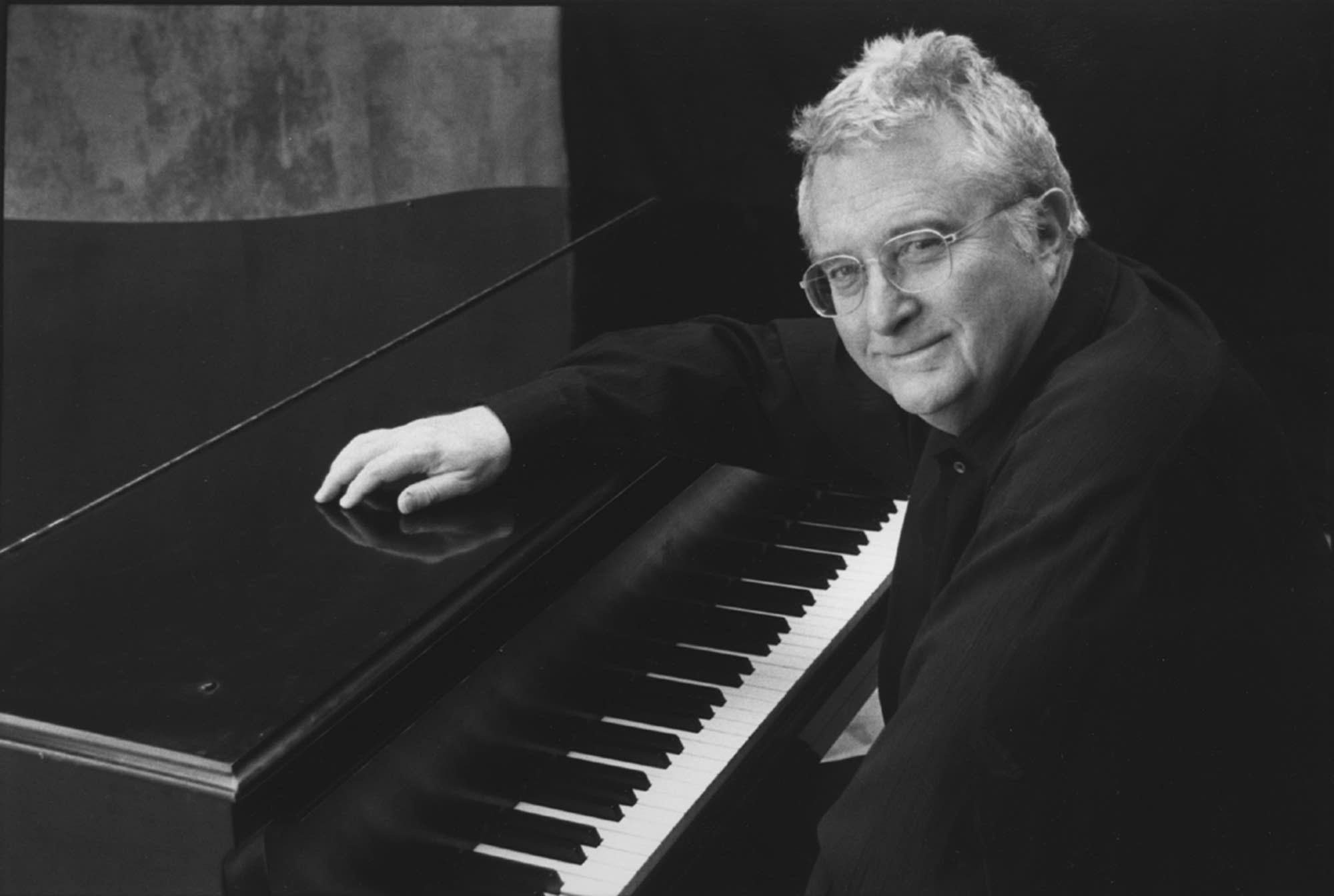
Zach McCormick: That song choice feels just like something that a couple of friends would pick out if they were playing together in the living room, too. Like, "You know 'Lonely Avenue,' right?" "Yeah, here, let me..." you know? And you're all of a sudden, you're comping the chords along, he's singing along to you. It really did. You captured that organic feel so well on that.
Jon Batiste: Yeah, it's like we were talking about Ray Charles. And just Ray Charles is, like — Ray Charles is the architect of soul music and one of the pillars of all of the idioms that we love and have been influenced by the most: Randy thinking about his ties to New Orleans; obviously, I'm from there; and just the roots of all the music that came out of New Orleans, through the Delta, up the river, and all this different vibrations of expression that have influenced the world. Ray is on the Mount Rushmore, if you will, of people who popularized and helped to proliferate that expression of music. And his repertoire had so many gems, and "Lonely Avenue," written by Doc Pomus, which was a friend of his, obviously one of the great blues writers, lyricists, and Ray, one of the great blues singers and country singers, jazz singers—
Zach McCormick: You name it!
Jon Batiste: You name it. So it was just like a very significant choice to do that song, you know, something 100 years later, just the idea of that song, and us being sons of Ray Charles spiritually, to connect on the piano and play that song, document that recording. And also just for Randy to have this opportunity to show he's still—
Zach McCormick: Still got it.
Jon Batiste: He's still ... It has not wavered. He's still one of the greatest. And I love being able to be — you know, this is one of the great things about having a platform and being successful in a certain way that I have: I've been blessed to be able to call my heroes, and they pick up the phone.
Zach McCormick: Yeah, totally. We were talking a little cinema here with this album, and I think it's so cool that this record, Big Money, came out the same year that Sinners came out, because I think both your record and that movie do this awesome job of kind of like showing and situating blues music at the heart of all American music. And I just, I thought that was so cool that they kind of came out in the same year. They also seem to have some similar themes to them, as far as, like, you know, capitalism and its interaction with art. Did you get to see Sinners? Did you feel any connection to that movie?
Jon Batiste: Man, I haven't seen it yet.
Zach McCormick: Oh, gotcha.
Jon Batiste: But I talked to Ryan Coogler, who, you know, by my estimation, is the greatest living director, and he told me about the experience of just going to Louisiana, and the first day, he had this great story of being picked up at the airport, and in the car, going all the way out to where they shot the film, he was being educated, proselytized, too, about Jon Batiste and all his music and all the things, you know? And he's like, "Yeah, I know Jon. I know Jon." Then it turns out maybe it was one of my relatives, I have a lot of relatives. But so then they get out the car after this long drive, and apparently he pulls out a horn, and he starts playing the horn to them, and it's, you know, maybe 2 a.m. or whatever, there on the set. It just felt like a christening.

Zach McCormick: Yeah, absolutely.
Jon Batiste: It was a moment. He was — at first, I thought he was sharing it because he was, you know, kind of like, "Who was this person?" But no, he was saying it because it felt like such a sign.
Zach McCormick: He received the local blessing—
Jon Batiste: It was a beacon that they were in the right place for that film. I can't wait to see it. The fact I haven't seen is because I know it's gonna be significant, so I want to not be on the road, not be in the middle of doing, you know, what we're doing now. We're on tour right now, for those who don't know. But I think that there's synergy: It's something that happens when there's a moment; you see that with the Harlem Renaissance, or you see different moments in history where artists are aligned and thoughts are aligned. And you know this is happening with the sort of repatriation of American art forms and values and a recontextualization of the history and the meaning of it, and how it relates to the contemporary age, how it relates to the time we're in right now, taking those things from the past and understanding them in a way that can illuminate the future. So it's a very powerful thing that I've seen happen with a few of my peers. And I think we're just in a moment where that's ... That's one of the dominant spirits of the creative age.
Zach McCormick: I think about the moment that you were talking about, the moment that we're in kind of right now, societally, and the title track for Big Money really feels like maybe reflection on that "greed is good" ethos that seems to have taken back over. There's a lot of grifting going on in America right now, you know? Have your views on that interaction between art and commerce changed throughout the course of your career as you've seen as much of the industry and all the different sides that you've seen?
Jon Batiste: When I think about what art was before it was a commercial entity, became a commodity, became something that you could sell and put on an album, a stream, right? It was the artist as citizen. The artist was someone in the community, who was knowledgeable about literature and had a certain wisdom and understanding of history and its connection to the rituals and traditions of a people. And you know, going back to the first drum, in the drum circles and the ways that music was a part of the fabric of everyday life, and there was music for different aspects of societal progression and generational progression. And the expression of music wasn't something that was bought and sold. It was even something that existed in the high courts, whether it was the commissioning of a work for the queen. Even that was a form of a service, a form of a homage, if you will. And the expression of music is aligned with the progression of technology, and when you had the advent of the phonograph and the vinyl recording to the CD to the streaming to now artificial intelligence, all of these things have evolved to create this robust industry around something that for centuries, there was no form of industry attached to it.
So I think that I've always wanted to get back to is what I call "social music"; just get back to the essential elemental understanding of what the music is, building communities around the entertainment industry, I think that can be obviously a beautiful thing, but music is much deeper than that. It's much more than that, and the power of it, and what it can be in the world is meant for much more than that. And if the artists forsake that, then that's the same as selling your soul for the silver and gold. That's the same as big money in the context of the political divide. It's the same as big money in the context of being able to buy policy and to change laws because of the size of the check. Everybody is accountable for how we respond to big money and in the way it stretches us beyond the natural limitations of the planet and pushes things beyond their natural state to a place of corruption and toxicity if we're not careful, and we're the ones responsible, we can change that. You know, big money is powerful, but nothing is more powerful than people power. And what can inspire people most? We find it in the arts. We find it in the creative expression of of music. We find it in the live performance that when we gather and we can inspire people to action and to combat apathy. You know, this is what we're dealing with.

Zach McCormick: Absolutely. Zach McCormick, joined by Jon Batiste in The Current studios today. Thank you so much again for joining us. Let's talk about this tour that you've been on. I've just heard from Lindsay back there, who just got to see you the other night. The tour's got like a circus theme going on here. And I thought that's cool, because, you know, circuses can be places of noise and chaos, and there's certainly a lot of that in the world, right? But circuses are also a place where people who maybe didn't fit in anywhere else, who other people might have labeled as freaks, even, you know, got to find a place of belonging and find a place where they could express themselves. So what do you like about that circus theme? How did you find your way to that, and why did you decide to make that theme for this particular tour?
Jon Batiste: The beauty of having a message that is universal, but what that truly means is we're all one, yes, we all have a heart and a soul, and we all want the same things: safety for our family, we want access to all our basic needs. But beyond that, we're all different colors, shapes and sizes, endless variations, ad infinitum. And that's the beauty of the circus. Everybody has a role to play. "This is the circus of love. Under our tent is revival and joy." That's what our banner says, literally, above the stage when you come into the show. And that's what we want to welcome in a time where people — we want to welcome everybody, because people now being put into these categories, these boxes, so that, you go to a place, and if people that don't agree with you or your values or how you think or the way you see things, then they're your enemy. And even with the generation gap, this perceived notion of a generation gap, this idea that we're separated by time, when we're actually all connected through time, it's a continuum.
So all of these things that have separated us, we want to be raging against that with a radical love and a radical acceptance that allows for people to then connect and find common ground. That doesn't mean we're going to have to agree. We shouldn't agree. In fact, this country is built on us not agreeing. This country is built on free speech and us having the ability to talk and fight for what we believe is right. And it's built on the idea that everybody has a divinity within, and we all have this divinity, and that's why we should love thy neighbor. That's why we should love our neighbor as thyself, because this person has God in them, and so do I, and I've been made in this image that's beautiful and wonderfully made to do exactly the thing that only I can do on this earth. So we should treat everybody with that sort of respect and love, and that's where we're coming from. I thought a lot about the correlation between the circus tent is one aspect, but then the revival tent—
Zach McCormick: I was gonna say "the revival tent." What else happens in tents? Yeah.
Jon Batiste: In early American tent culture and the aspect of how people, you know, would escape to go to the circus, because that's where they felt like "Finally, I found people where I can feel belonging, feel acceptance." But then also people went out of society into the revival tent so that they could have an encounter with God, with the Creator, with the expression of our divine essence, under the Word of God, under study of Scripture, under the understanding of how we're all connected and how this all works. This isn't just by some strange design. So there's hope in that. So all of that's wrapped up in the mythology of how we've presented the show. And when you come out to the show, it's much more than just a concert. It's a spiritual practice. You see, we connect to people. This isn't a concert, this is a spiritual practice. So when you connect to the moment, there's a frequency in the air. There's a vibration that you feel in your body, that when you leave, we really give you a sense of transformation.
Zach McCormick: You know, to extend that circus thing just a little further, and forgive me here, I also thought about the story of Pagliacci and the idea of "Tears of a Clown," when I hear the lyrics for a song on the new record, like, yeah, exactly when I hear a song like "At All" on that new record with the lyrics of that, on my reading, seem to kind of grapple like parasocial relationships, celebrity, persona. Do people know the real you? You're trying to, every night, deliver this incredible, universal message of love, extend that heart out to people, but at the same time, you're a human being, too, who has an element of privacy, some peace that you probably need to protect. How do you balance that?
Jon Batiste: Yeah, man, it's life. It's hard to balance all the things. And then when you add celebrity on top of it, and you add the expectation that if you want to accept that expectation, and if you don't want to accept that expectation, it's still something to grapple with. So you have to deal with this idea of identity and understanding first who you are and what you stand for and what your lines are, and where you draw those lines, and what you won't do in protection of the things that you value and prioritize, first: family, your art, your faith, your community, your values at all. You know it's like, "I ain't gonna take this flight to London tomorrow..." It's this idea of drawing lines. Every lyric is a statement of a boundary. And then this idea of, "if she understands me, then you don't have to at all," you know, "she" can be your partner, your friend. It can be the muse.
Zach McCormick: Could be your mother, you know, yeah. Could be a person that then your family, that you connected to.
Jon Batiste: Yeah, yeah, yeah. It's exactly right. I love that kind of song. I'm inspired a lot when I listen to the writings of Bill Withers and Curtis Mayfield and thinking about how, you know, they're not considered necessarily in the Americana canon, but they're folk writers as well, and the stories they tell are often about the lines they've drawn to etch out their identity in their manhood. They write very masculine songs from the space of protection, from the space of being a clear-eyed, strong-willed person in a world that's trying to sway them off their path. And that's a powerful thing to sit down and deliver that song to an audience through an album, because it kind of lets people know "From henceforth, you know where I stand."
Zach McCormick: Right. I was wondering about that, because I was like, you know, "This is a guy who's been on TV so much, now he's kind of embarking on these tours" where you're meeting a new audience every night, trying to give them that same level of connection. And so I was like, I wonder if these lyrics in this particular tune, are we hearing a little bit of Jon Batiste saying, "I'll go there. I'll go this far for you. I'll welcome you into the tent, but I do have to draw a line somewhere."
Jon Batiste: Yeah, you have to have lines. If you if you don't have lines, then that means you don't have as much care or love for the others that are in your family, your friendships, your community, the people you serve as you think you do. It's important, because if you don't have those lines, then at some point, signals will get crossed. Intentions will get flipped. Actions that you want to take, you won't have the energy or the fulfillment to continue to be generous in the same way. You won't have all that you need to be all that you're meant to be.
Zach McCormick: So by protecting a little bit of you, you're, in a way, preserving yourself for the folks that really need you.
Jon Batiste: Yeah, it's like a singer. When you see the great, you know, Leontyne Price, or you see — I love, you know, I'm a YouTube historian, I'll go and watch people on YouTube warming up. Just, you know, doing the most mundane things. I used to love watching Ray Charles' sound checks. Just because I wasn't born, so I couldn't be there to see but, you know, to watch it, and you see ... Or Prince, you know, in rehearsal.
Zach McCormick: You're holding the guitar. I wanted to talk to you about digging into the guitar as an instrument on this new record.
Jon Batiste: I've been holding this this whole time.

Zach McCormick: Because this is probably one of the first records where we're hearing like a ton of guitar for you, you know, on this new album. What attracted you to digging into the guitar for Big Money? Was it the blues roots? Was it something else? What kind of got you into using this instrument after so many years on this one?
Jon Batiste: Man. I think about my dad. You know, my dad is a bassist and a vocalist, and his first instrument was the guitar, and he switched to the bass so he could play in the band with the family.
[singing] Lot of talking going on while I sing my song.
But do you hear me? I say, do you hear me?
When I look up to the stars, I know exactly who we are.
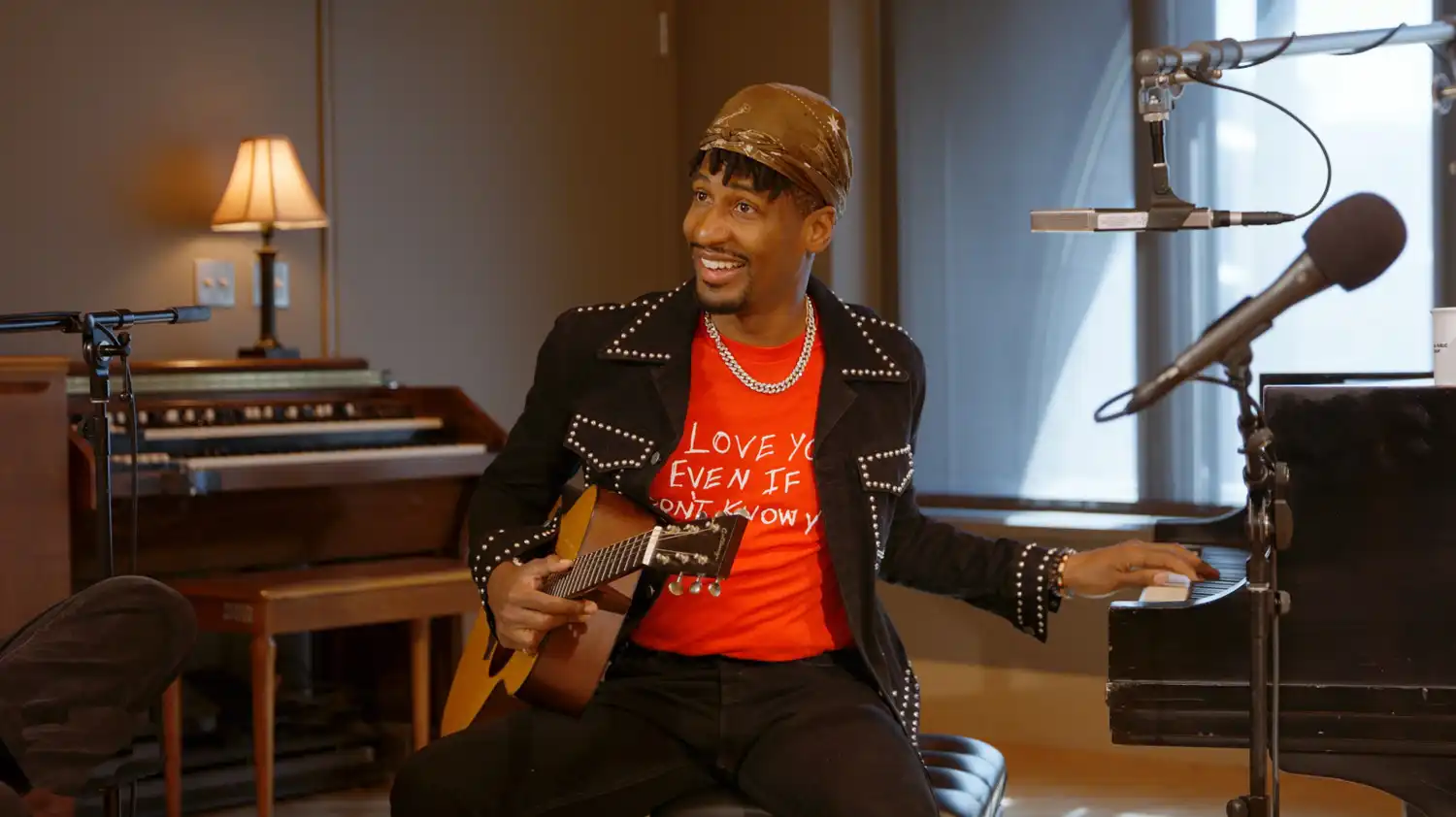
It's a storytelling instrument. It's the madrigals, the troubadours, the griot. It's the one that is able to move through the world, telling stories and soundtracking them. It's the instrument that allows for a certain type of divine encounter, because when you speak to somebody with that sort of tonality behind it — I was just kind of demonstrating just now — there's a certain directness and translation that happens. The words mean one thing, but then when you have that backdrop, it means something else. The stringed instruments have a different frequency and a different way that they impact the soul, and the guitar is the one that I think we're most open to and most resonant with in this time. It's why it was the thing that the sharecroppers and the farmers and the blues musicians gravitated to, and it has ancient roots. It goes back, you know, you're talking about the Khora, and you go back into through the diaspora, and you find the stringed instrument, even going back to the scriptures in the Bible and Jubal and the idea of the stringed instruments. So I just felt like we were definitely going to be telling stories. And I was playing the guitar a lot on the road. My last tour was my first-ever headline tour, is was last year, and you know, I came here, we played First Avenue, and, you know, I was in there till four in the morning, playing and just being in the space of playing a lot of guitar on that tour, after the shows like that, or like, on the tour bus, carrying it around. And it was my unorthodox form of journaling. You know, Suleika [Jaouad], my wife, the greatest artist that I know, is truly one of my biggest inspirations, she journals and has a journaling practice. And I was thinking about just the idea of journaling with the guitar and moving around on that tour. So it was a very, very honest way of expressing that led to "Big Money" the song. And then I did "Big Money" the song on the road, and then six months later, my subconscious told me, "Oh, this is a guitar album."
Zach McCormick: Yeah.
Jon Batiste: Whatever that means.
Zach McCormick: Yeah, you're not gonna just play guitar.
Jon Batiste: No.
Zach McCormick: But you felt like that was the lead instrument that you wanted to dig into.
Jon Batiste: Yeah. It was all those things: The storytelling, the resonance of how that will convey these messages, this approach to recording, this sort of back-to-the-essence-of-the-recording style of the first recordings ever. Thinking about, you know, when people would go around the country and find regular, everyday working people and be like, "Can you record?"
Zach McCormick: Alan Lomax sticking a tape recorder in front of some people in a field.
Jon Batiste: In the field!
Zach McCormick: Yeah, exactly.
Jon Batiste: It would be the guitar.
Zach McCormick: Yeah, right.
Jon Batiste: Or violin, you know. So, like the record, "Petrichor," when I was thinking about that, that was really, like an Alan Lomax recording; that was recorded on the tour bus, and I'm playing each of the instruments. That was the only one that wasn't one take, because I'm playing everything.
Zach McCormick: Doing your own little Prince moment there.
Jon Batiste: Yeah, picked up the mandolin and the violin and the guitar and just one microphone, you know, on the tour. But it was just one of those kind of moments. But it was part of my journaling, and then it led to a very honest set of songs that became the sort of — those were the foundations: "Big Money," "Petrichor" and "Maybe." Those three came before there was a decision to make an album, a decision to go guitar. But when those three were there, it was, oh, it was two weeks, we recorded the rest.
Zach McCormick: I was gonna say, because I had read that this came together really quickly, too. Was there something exciting about again, you've been doing these projects with symphonies, with TV shows, where production schedules get so complicated. Was there something exhilarating about being able to just go, "All right, I got the songs; two weeks, let's get it done." ?
Jon Batiste: Well, I didn't set two weeks as a timeline. It just was what it was. I didn't set a lot of time. I didn't have, like, months. I didn't have a month even. But it wasn't a limit. It was urgent to capture it. That's what drove it most. You know, I always feel that there's stuff that I want to do. I have a million ideas I'm always working on. I'm constantly recording. I never have a time where I'm saying — and maybe I should, at some point, I'll do that — but I never have a time where I say, "I'm about to just focus on recording my album." Sometimes I'm doing it more than others, but I'm always recording. I'm always writing. And that means that there's maybe 10 drafts of an album that could be the album at any given time. The archive, you know, speaking of Prince Rogers Nelson, I relate to that in a very, very deep way. I'm reading this book, from the Sign o' The Times era through — no, just after Purple Rain through Sign o' The Times with his studio logs and the activity of how he would record on tour, and just the aspects of what he was doing during that era. And it's so — some of the stuff is eerie, because it's like, "Whoa!"

Zach McCormick: You feeling similarities to your own process?
Jon Batiste: Yeah, which I enjoy. That's what I love about reading bios and studying histories. But yet, so I never thought like, "OK, now this is the two weeks where I'm gonna make the album." But it just felt urgent. It felt like, "Oh, wow." Like I said, those songs, "Big Money," "Petrichor," "Maybe," they were all captured, and the songs were written and "Maybe" was captured. It was something that I sat down at the piano and recorded.
Zach McCormick: I was going to say, it sort of sounds like you're maybe even feeling it out. You're not improvising, but you're ... it's of the moment.
Jon Batiste: It was completely spontaneous.
Zach McCormick: Oh, wow.
Jon Batiste: Completely. There was no premeditated lyric. There was no other takes, there was no edit. There was nothing that was done; just completely channeled. I've never done that before and to that level. I've done it with instrumental music, I've done it with maybe a verse, or a verse in a chorus even, but never a full song: intro, verses, bridge, interlude, outro. And I was like, "Oh, you got to catch it now." It's like Quincy Jones, he would always tell me, "If you don't do it, it's going to go to somebody else." You know, Leon Bridges—
Zach McCormick: Yeah, that lightning in the bottle.
Jon Batiste: "Lightning in a bottle," yeah, right. That's what they say, right? He said, "Man, yeah," he told me, "man, I would tell Mike [i.e. Michael Jackson; editor’s note: Jones produced three hit albums by Jackson: Off The Wall, Thriller, and Bad.], 'If you don't go and do it, it's going to go to Prince.'" But, you know, it's urgent. I like that because it illustrates the urgency of catching the idea.
Zach McCormick: Trying to chase that creative moment.
Jon Batiste: Yeah, yeah. So we caught it, and then once we caught it, it was like, "Oh, we're there."
Zach McCormick: And how do we fill in the rest of the record now, too? I think about a collaboration with No I.D., the song "Angels," which has this really cool Lee Scratch Perry, Billy Bob Bo Bob doing his kind of, like dub reggae thing going on, too. Sounds like the Willie Neslon reggae album.
Jon Batiste: Yeah, yeah, yeah. Man, I love that record. "Angels" was one of my favorites. I did a lot of recording with World Music Radio, we did a lot of recording in different parts of the world, and obviously influenced by different music around the world. And this recording, specifically, is kind of the thread that connects both albums. "Angels" goes back to the World Music Radio universe, which was, I mean, in many ways, the process for that album was similar, but the result was the complete polar opposite, but just this idea of capturing these moments and building it out, that was why I wanted "Angels" to be at the end of Big Money. "Angels" is the last track on the album, so when you listen to the album, you go on this journey, and then you hear Billy Bob Bo Bob, who was the alter ego, the kind of host of World Music Radio, he reappears at the end of the Big Money album and speaks to you from his dimension. And there's a lot of Easter eggs in that record if you listen to it, just as a — it's an interesting thing. Some people have actually already caught some of the stuff and said, "You know, I heard what you did there." But Dion, No I.D., is my kind of copilot for this album.

Basically we recorded, in that two weeks, it was Dion, he basically helped to kind of sculpt that two weeks in a process that would get us to where we needed to get. And then Nick Waterhouse basically, was my kind of straw boss with the band, because we did everything on the stand with everybody playing live. And, you know, I'm the artist and also band leader, but Nick is really like leading the band.

Zach McCormick: Maybe director, "director of photography" to use that film thing again.
Jon Batiste: He's invaluable. So that was kind of our three-headed monster. And with "Angels," that was a lyric of, we'd been sharing songs and talking for a while, and "Angels" was a lyric that I had from a song that Dion and I had worked on. And once we got the band in the room, once we recorded all the other songs, "Angels" was the last one where we were saying, "Oh, this is where that lyric can fit." So there was a lot of full-circle moments like that. But "Angels" is really great because it feels connected to World Music Radio, but still fits in the world of Big Money, and it has this sense of — it's a cliffhanger. The album, I like cyclical albums, where you listen to the last track, and when you go back to the first, there's a connection to the sequence that informs it. Each time you listen again, you're hearing it in a different way, and it encourages you to hear different elements in each of the tracks every time, based on how it was sequenced. So "Angels" is the perfect portal for that.

Zach McCormick: And the flipside with the Andra Day duet at the start, both of these really lush, kind of lovely tunes, that sort of bookend an album that's maybe a little more spare, whatever you want to say, it's, you know, there's less, maybe, of that sweetness element. You're bringing in other stuff in the middle there, too. I don't know.
Jon Batiste: Totally. No, you caught it. It's a really — it's tough to put in the words, because it's intangible. There's something that happens when you sequence an album like this that affirms its identity, and you could sequence it in different ways to affirm different parts of its identity. But ultimately, this was the truth of it when we put these tracks together in this way. Natalie Hemby and I wrote "Lean on My Love," and that's a community love song. Agape. That's a song that's about finding all of the different people in your life that you know you can lean on, and singing that and speaking life through those words into them, into the situation.
Zach McCormick: Zach McCormick, joined by Jon Batiste in The Current studios. This new album, Big Money, is incredible. Thank you again so much for coming in and chatting with us about it. I had really wanted to chat with you really quick about this record that you did back in 2020 with our local guy, Cory Wong. It's called Meditations. It's a fantastic album, and I love the way that Cory Wong, I've heard him describe the process of you two getting together, the way he tells it, he basically invented a trip to New York City out of whole cloth as an excuse to come work with you. It evolved out of a session that I think he did right around the corner here at the Fitzgerald Theater. Can you talk about how you two linked up and what that working on that album was like?
Jon Batiste: Yeah, he's one of my favorite musicians. It's like a thing that happens when you meet a musician. We do this where we, you know, you know how it is, man, what? You just figure out a way to keep the jam session going, to just keep the music going. Something has to happen. We didn't have plans to make an album. You know, we met—
Zach McCormick: Live From Here.
Jon Batiste: Live From Here. Yeah, exactly, that's right. So when we met, I was hosting that in in place of Chris Thile, who's another mutual friend of ours, great musician, and put this incredible band together, and it's like, "Who's the guitar player? Man, his guitar."

Zach McCormick: Yeah, he's great.
Jon Batiste: Killin'! We got to play more. So, long story short, we found a reason to do some work together, and we did a show — no, no, we were actually on The Late Show. Stephen Colbert.
Zach McCormick: Yeah.
Jon Batiste: On The Late Show. And on The Late Show, we were doing the sessions in between sound check and the taping.
Zach McCormick: So that meant having fun.
Jon Batiste: Yeah, so basically, what that meant was, for a week, we were playing nonstop. So that's what happened. It was like we engineered a way for us to explore this connection that we had onstage, on Live From Here. And it ended up being an album. That time was really a tough time in the world with the pandemic and the moments of isolation that were happening. So the theme for the album, I remember that really came from us wanting to create something to serve that moment and to speak to that isolation: Meditations. If you listen to all the tracks, it's really one long meditation. It's like again, speaking of the sequence, it is an album that you can put on and seep into as you would meditating alone.

Zach McCormick: Speaking of The Late Show, you know, given the news recently that just came out this summer, Stephen Colbert wrapping up the show after many years. I'm just wondering if you wouldn't mind reflecting a little bit on your time that you spent with the show. I know you left to do your own touring, and I'm sure that that's been amazing, but also now to see that it's wrapping up after all these years, it's an institution. I mean, how does that feel for a guy like you that spent so much time there?
Jon Batiste: It's tough. I think it's tough to have something like that not be on the cultural stage anymore, because it spoke to many different aspects of society, and in a way that, you know, we really need all those different perspectives. If you just have one perspective, all the aspects of society it spoke to as well, the obviously, the political, but culturally, you know, just the kind of range of guests, you know, the arts and the sciences, all of the ways that he was able to have conversations on many different levels. The music that we played on the show, the range of music we were able to have on the airwaves, going into people's living rooms. You know, that's important, that stuff is very, very significant. And when you remove that, and you don't have something or somewhere where people will be able to have those conversations, then that's when freedom of speech is — you know, I'm trying not to, I don't want to get so deep, but it's just a sad thing to have something happen where you don't ... It's sad for me, as I see my friends and people who I spent seven years with not have a place to go and share their gifts and brighten the world and brighten the airwaves, but the implications of it, that, I've been thinking a lot about that and what we can do, and how we can, you know, prevent the worst case scenarios coming to pass.

Zach McCormick: Yeah. We were talking a little bit earlier about the Beethoven Blues record, and I noticed that when you put that record out, you kind of billed it as sort of a part one of a potential series, maybe of piano music, or maybe it's your blues interpretations of classica.l I was sort of curious about, like, where you would love to take that series somewhere down the line if you got your druthers, you know?
Jon Batiste: I just want to keep playing piano.
Zach McCormick: Yeah.
Jon Batiste: I love it. And there's a series of recordings that I want to present that aren't necessarily all classical or all anything, but I just want to present all the different ways that I relate to the instrument and relate to the repertoire, and the power of transformation that can come from the good old 88, the black and whites. And I have a perspective on that, so I thought it would be great to have a series to kind of share that and hopefully encourage other people to get on the instrument and share their perspectives.
Zach McCormick: Not feeling torn between these two. You've been spending a lot of time with the guitar, but the piano is always going to be there for you.
Jon Batiste: Yeah, the guitar is amazing. Any instrument that I have a vision for, I feel compelled to spend time until I get that vision out, but the piano is home base. This is, right now, this is a is my storytelling device. I'm not really trying to shred. I'm not trying to be Cory Wong. But, you know, I love it. I just love the idea of being able to express the depth of my lyricism with different textures supporting it. And there's a difference when you have someone playing the guitar versus when you're playing it. We were talking about those magical storytellers, the troubadours, we talked about how, you know, the oral tradition all the way going to Africa, and the way that that is facilitated is very solitary. It's a singular messaging technology. And when you tap into it by playing the guitar, it's a very powerful thing. So I'm very into that, and I'm into adding that to the repertoire of how I serve the public.
Zach McCormick: Jon Batiste, thank you so much for joining us here in The Current studios. The Big Money Tour, it's rolling right now. The new album's out now. Thank you so much for your time. Thank you for playing for us. It's been a real pleasure chatting with you today.
Jon Batiste: Thank you so much. God bless. I'm so glad to be here. Oh!
Zach McCormick: Yeah, totally.
Credits
Guest – Jon Batiste
Host – Zach McCormick
Producer – Derrick Stevens
Executive Producer – Lindsay Kimball
Graphics – Natalia Toledo
Digital Production – Reed Fischer, Luke Taylor
External Link
Jon Batiste – official site